
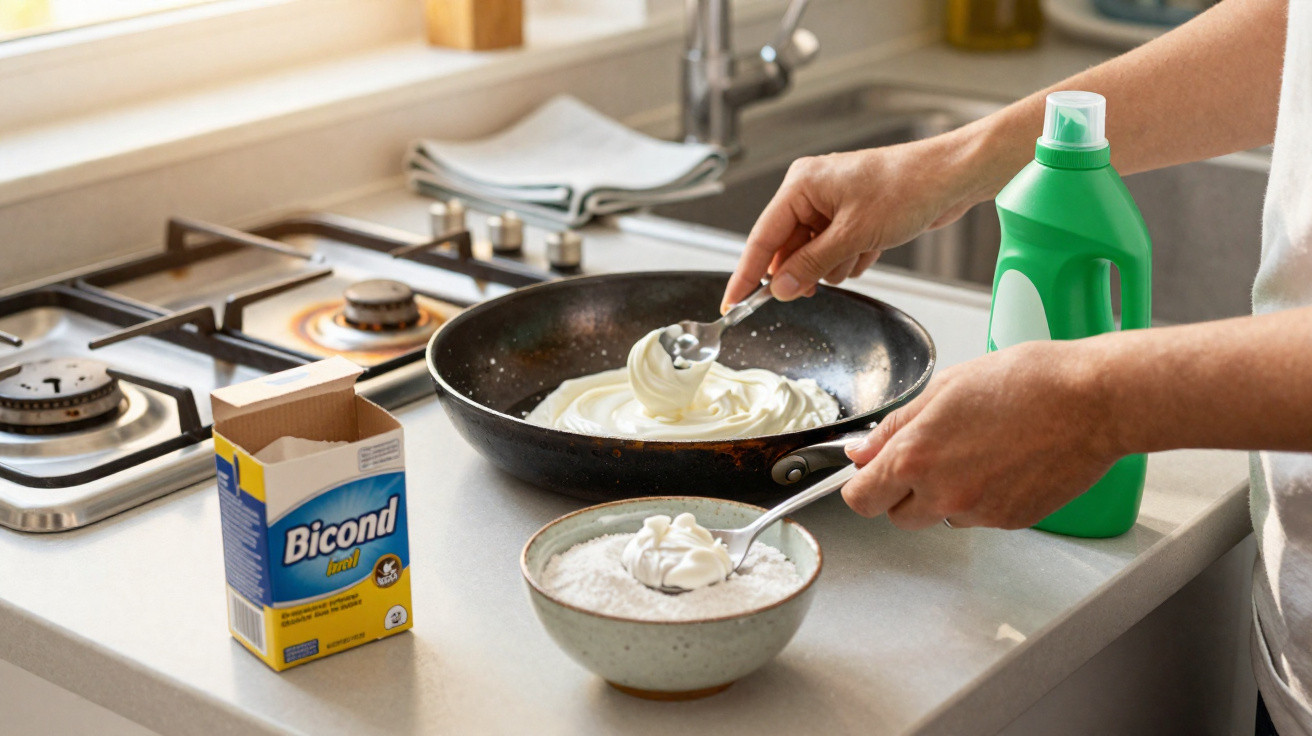
Combining bicarbonate of soda with washing-up liquid creates a handy paste for shifting stubborn grease, stuck-on food and burnt-on grime from hard-wearing surfaces. The bicarbonate of soda provides gentle abrasion, while the washing-up liquid helps lift grease-particularly useful on the bottoms of pans, oven shelves/grills and the hob’s metal parts.
Why do bicarbonate of soda and washing-up liquid work better together?
Bicarbonate of soda has fine particles that loosen residue through light friction, without needing a very harsh scouring pad. Washing-up liquid, meanwhile, contains surfactants that surround oily deposits and make them easier to rinse away with water. When mixed into a paste, both ingredients stay on the dirt for longer than they would in a thin, liquid solution.
- Bicarbonate of soda helps break up carbonised residue.
- Washing-up liquid targets oils and grease in particular.
- A paste consistency keeps the ingredients in contact with the dirty area.
- You typically need less scrubbing effort to remove the crust.
What ratio should you use to make the cleaning paste?
A practical starting point is two parts bicarbonate of soda to one part mild washing-up liquid, mixing until you get a thick paste that spreads easily. If it turns out too dry, add a few drops of washing-up liquid or water; if it becomes runny, mix in a little more bicarbonate of soda.
There’s no need to make a large batch. For a small section of a hob, for instance, two spoonfuls of bicarbonate of soda and one of washing-up liquid are usually enough. Ideally, mix only what you need for that specific clean and throw away any leftover paste afterwards.
How to use it on a burnt pan and hob burner
On tough, durable surfaces, apply the bicarbonate of soda and washing-up liquid paste directly to grease or burnt-on residue and leave it to work for around 10 to 15 minutes. This gives the washing-up liquid time to penetrate the grime and allows the crust to absorb moisture before you start scrubbing.
- First remove any loose debris with kitchen roll or a cloth.
- Spread a thin layer of the paste over the encrusted area.
- Wait roughly 10 to 15 minutes.
- Scrub with a soft sponge or a brush suitable for the material.
- Rinse, or wipe with a damp cloth, until all product is removed.
Why shouldn’t the mixture be used on every surface?
Even though it looks like a very fine powder, bicarbonate of soda is still abrasive. On non-stick coatings, repeated scrubbing can scratch or wear down the layer that prevents food from sticking. That’s why pans with Teflon or other delicate coatings should be cleaned according to the manufacturer’s guidance-typically using washing-up liquid and a non-abrasive sponge.
The same caution applies to polished glass, shiny surfaces and some metal finishes. If you scrub too hard, the paste can leave tiny scratches or dull the shine. On glass hobs, for example, it’s safer to use products and scrapers made specifically for that type of surface.
When is bicarbonate of soda with washing-up liquid actually worth using?
Bicarbonate of soda with washing-up liquid works best when you’re dealing with a mix of grease and stuck-on residue on materials that can handle mildly abrasive cleaning. The outer base of stainless-steel pans, oven shelves/grills and removable metal hob parts are among the most suitable uses-always doing a small, discreet patch test if you’re unsure about the finish.
The benefit comes from splitting the job between the two ingredients: washing-up liquid loosens grease, while bicarbonate of soda helps lift what remains stuck through gentle mechanical action. Paying attention to the contact time and the surface type matters more than scrubbing hard, because the same abrasion that removes a crust can also damage a delicate coating.



Comments
No comments yet. Be the first to comment!
Leave a Comment