
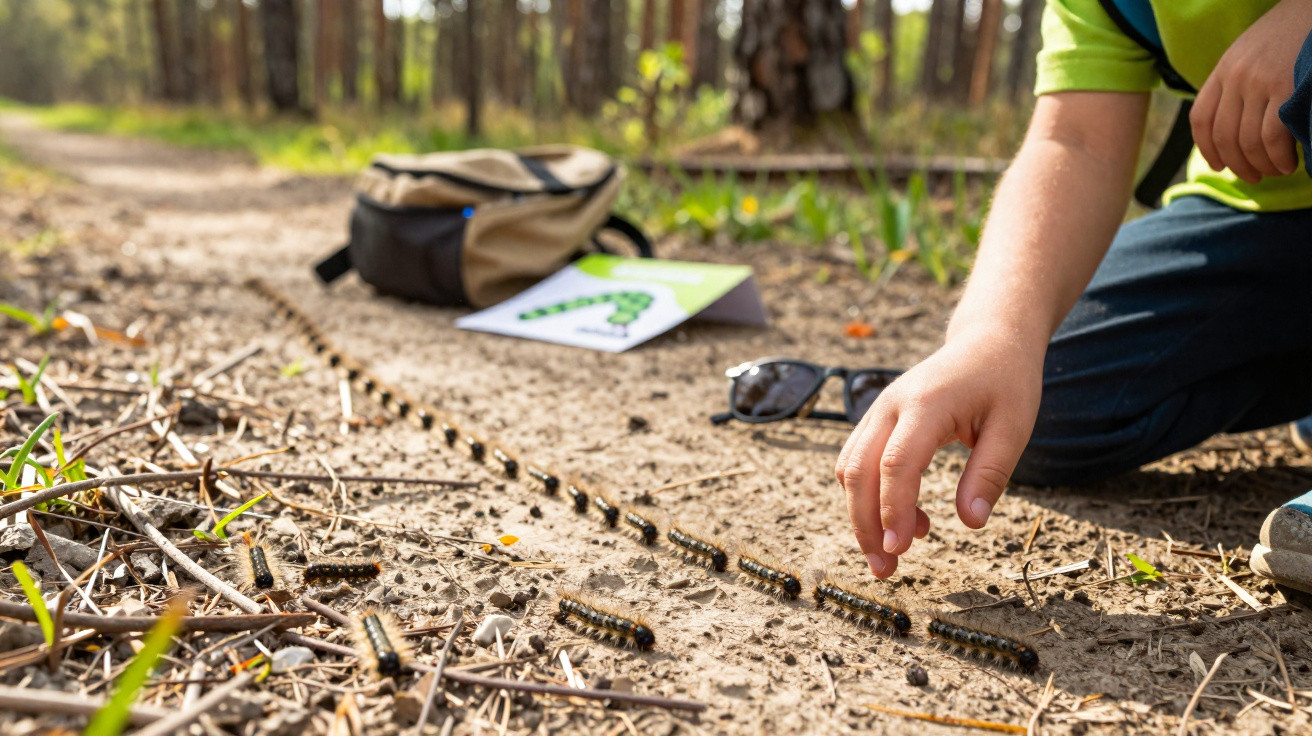
A line of caterpillars moving head to tail may look far too orderly to pose any danger. With processionary caterpillars, however, the greatest concern is barely visible: thousands of microscopic urticating hairs can shed from their bodies and remain in the surrounding area, causing reactions even when nobody directly touches the animal.
Why do processionary caterpillars travel in a line?
The name processionary comes from their distinctive habit of moving in single file. The caterpillars leave their nests to find food or travel between parts of a tree while maintaining contact with one another, forming a route resembling a small living train. This behaviour is particularly associated with the oak processionary and pine processionary caterpillars.
Although the line makes the group easy to identify, it is not an invitation to get closer. European forestry authorities advise people to keep away from both the caterpillars and their nests. Children and pets should also be kept at a distance, as curiosity and direct contact raise the likelihood of exposure to the hairs.
Where are the hairs that cause irritation?
At their more advanced stages, processionary caterpillars develop extremely small urticating hairs, which differ from the longer hairs visible to the naked eye. These hairs contain substances that can irritate the skin and mucous membranes, leading to itching, redness and eye discomfort. More sensitive people may experience more significant respiratory symptoms.
The concern is that the hairs detach easily. They can remain caught in old nests, bark, leaves, clothing and other nearby materials. As a result, the hazard does not simply end because the caterpillar has moved away from a particular spot or because no one has touched its body.
Can you react without touching a processionary caterpillar?
Yes. Microscopic hairs can be carried by the wind and reach the skin, eyes or respiratory passages. This is why official warnings stress that abandoned nests should not be handled and colonies should not be removed without suitable equipment and training. Indirect exposure is a major part of the risk.
In the United Kingdom, management of the oak processionary caterpillar involves tree monitoring and restrictions in infested areas. The species has become a public-health concern precisely because its hairs can remain in the environment beyond immediate contact with the caterpillar.
- Do not touch the caterpillars, even if the line appears slow-moving and easy to inspect closely.
- Avoid old nests, as urticating hairs may still be lodged in the material.
- Keep children and pets away from trees marked as infested.
- Seek medical attention if symptoms are severe, particularly if breathing becomes difficult.
Watch the video shared by the YouTube channel Germano Woehl Junior, showing the caterpillars travelling in procession.
What should you do after exposure?
If hairs reach the skin, avoid rubbing the area, as this may spread them and worsen the irritation. Public-health guidance commonly recommends removing contaminated clothing, washing the affected area and seeking advice from a doctor or pharmacist according to the severity of the symptoms. The eyes and respiratory passages require particular care.
Breathing difficulties, substantial swelling, dizziness or a widespread reaction should not be dismissed as ordinary itching. Prompt medical care is needed in these situations. With mild exposure, symptoms are usually short-lived, but reactions differ from person to person and may be worse for people with allergies or asthma.
Why should this striking line be viewed from a distance?
Their collective movement makes processionary caterpillars easy to photograph, yet their defence operates on an almost invisible scale. The caterpillar does not need to bite or chase anyone: it is enough for hairs to become detached and land on a nearby surface for the surrounding area to become a potential source of irritation.
The safest way to observe them is from a distance. The contrast between the orderly line and the microscopic defence explains why these animals attract so much attention. If you find a concentration in a tree, park or garden, do not attempt to remove it yourself, and notify the person responsible for the area where there is a risk of public contact.






Comments
No comments yet. Be the first to comment!
Leave a Comment