
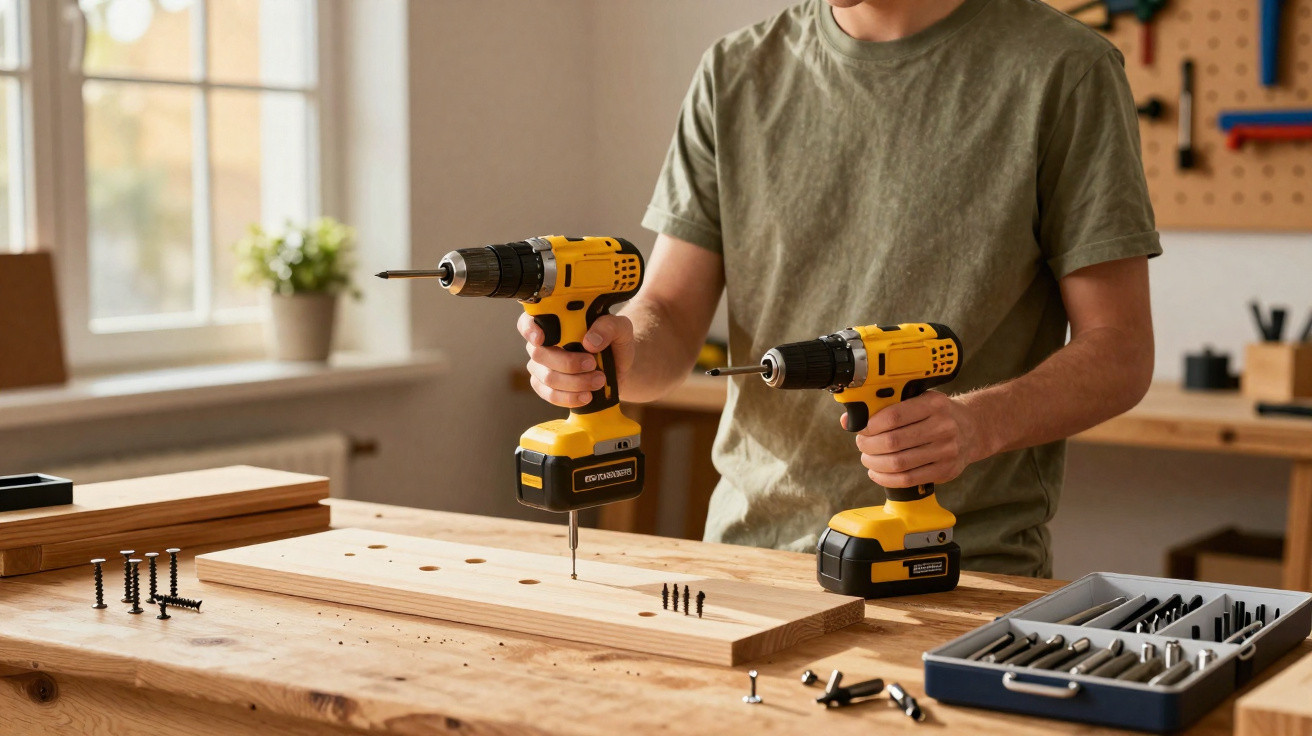
A drill and a screwdriver can look like similar tools, but they were designed for different jobs. One is built to create holes in tough materials, while the other focuses on control when tightening and loosening screws with greater precision.
What is the main difference between a drill and a screwdriver?
A drill is intended for drilling into surfaces such as wood, metal, plastic and masonry. It does this through rotation, using the correct drill bits and, in some models, an impact (hammer) function to get through harder and more resistant materials.
A screwdriver, by contrast, is designed to drive screws in and out. Its key advantage is torque control, which helps prevent the screw head from stripping, the screw sinking too far, or the workpiece being damaged during assembly and fixing.
The distinction is easiest to see here:
- Drill: recommended for making holes with drill bits across different materials.
- Screwdriver: made for tightening and removing screws with controlled power.
- Torque: on a screwdriver, adjustment helps avoid damage to both the screw and the piece.
- Masonry: typically calls for a drill with suitable power and the right function.
- Hybrid models: drill/screwdriver combinations merge functions and often create uncertainty when buying.
What is a drill used for at home?
At home, a drill is helpful whenever you need to make space for wall plugs, screws, brackets, shelves, pictures or light installations. It performs best when you pair it with the right bit, select an appropriate speed and keep a steady hand during drilling into the surface.
For walls, some drills include an impact function, which makes working with concrete and masonry easier. For wood and metal, the better approach is to use dedicated bits and manage the pressure to avoid splitting, overheating or an uneven finish.
What is a screwdriver used for?
A screwdriver is well suited to flat-pack furniture, fitting hinges, securing light parts, removing old screws and speeding up repetitive tasks. It cuts down on manual effort and offers more control than a standard hand screwdriver during assembly and repair work.
Control is the key word.
A screwdriver helps prevent over-tightening. Torque adjustment stops or reduces the force once the screw meets the set level of resistance.
That makes it easier to protect wood, MDF, hinges, handles and screw heads.
This control becomes particularly important with fitted furniture, MDF panels and delicate surfaces. Without it, a screw can go past the ideal point, crack the material or lose grip, harming both the fixing and the durability.
It tends to be most useful for tasks such as:
- Assembling and dismantling furniture.
- Fitting hinges, handles and light brackets.
- Tightening screws in wood, MDF and plastic.
- Repetitive jobs that would be tiring with a manual screwdriver.
Why do hybrid models confuse so many people?
Many current tools are sold as a drill/screwdriver, combining a chuck, torque control, a battery and variable speed. This is convenient, but it can mislead anyone expecting a single tool to handle every type of wall or material.
A hybrid model works well for wood, furniture assembly and light drilling, but it may struggle with hard concrete if it lacks impact, sufficient power and an adequate battery. That’s why your choice should be based on how you’ll use it, not simply the name printed on the packaging.
Before deciding, check:
- Whether the tool has an impact (hammer) function for masonry.
- Whether it includes torque control for delicate screws.
- The power rating or the battery voltage.
- Which drill bits and driver bits are included in the kit.
How do you choose the right tool for each task?
If your goal is to drill into a wall, fit shelves or work with more resistant materials, a drill is usually the better option. In alternative situations-such as guidance on drilling a wall without a drill-being careful with the surface remains essential and preventive.
For furniture assembly and driving screws with a clean finish, a screwdriver is typically the more comfortable choice. If you handle a mix of small repairs, a hybrid model can be worthwhile, as long as you respect its limits and use it with protection and attention.






Comments
No comments yet. Be the first to comment!
Leave a Comment