
Morgan, wood, and what people think they know
Fancy a quick round of car-brand word association? BMW: grilles. Jaecoo: Poundland. Morgan: wood. Whether you’re as ancient as the Malvern Hills nearby, or still not quite tall enough to peer over those running-board front wings, you probably file Morgan away as the defiantly traditional British sports car builder that uses timber.
That idea isn’t completely wrong - but it’s not the whole story either. Six years ago, Morgan moved the venerable Plus Four over to a bonded aluminium chassis. Even so, in the new £102k Supersport, those elegant, sweeping panels are still carried by a hand-made ash frame. Around the benches, the company continues to rely on huge wooden panel formers - like railway sleepers from a Salvador Dalí dream - to press those familiar, flowing shapes.
The catch is that you only really spot the timber if you make the trip to Morgan’s 112-year-old works down Pickersleigh Road. So how do you take that enduring Morgan association - wood as a lightweight, sustainable, versatile wonder-material - and put it front and centre, so it can be appreciated, admired, and celebrated? That’s where David Young comes in.
Photography: Tom Barnes
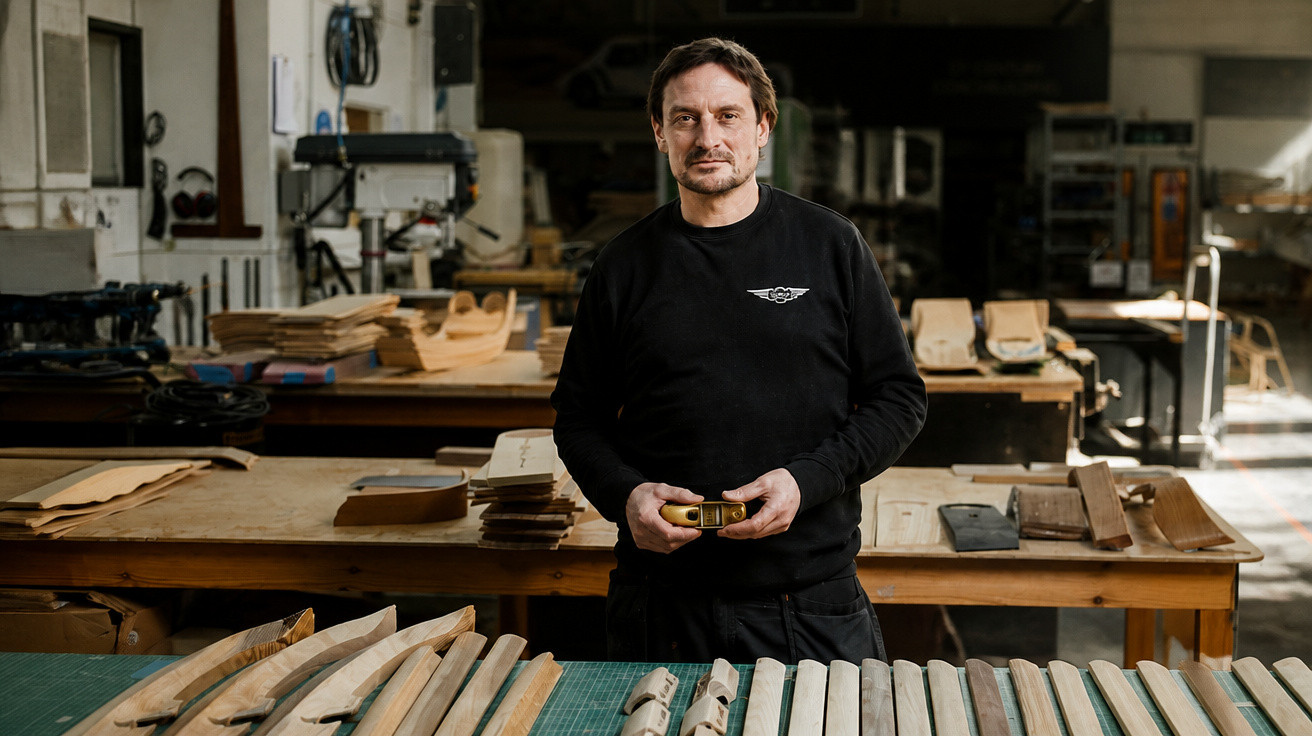
David Young, Morgan woodworker: “I’m just a woodworker.”
“‘My job title?’ Erm, I don’t really have one. I’m just a woodworker.” He says it with disarming modesty as he shows me around his ‘office’: a sweet-smelling corner of the wood shop inside one of Morgan’s characterful red-brick outbuildings. He could easily pass as ‘head craftsman’ or ‘wood whisperer in chief’, but he’s content with ‘just a woodworker’.
He didn’t pick up the trade at Morgan. “I’m a cabinet maker,” he tells me. “From the age of 16, I worked for a company just over the hill making high end furniture. I worked there for 26 years, and learned a lot, then I had an opportunity come up in Wrexham. Another company prised me away. Sadly I was only there about six months before my mother got ill and I thought, ‘well you only get one mum, don’t you?’ so I thought I’d better find something nearer home.”
While he talks, he flicks through a drawer and pulls out photos from his portfolio. “This is called a Vortex cabinet. I did one of these for the Queen’s nephew, David Linley. You can still get them now through Linley – about £110,000. It’s artwork, really.” With a wry smile, David admits he has no idea how many hours it took to build.
Learning the craft: engineering, loss, and an apprenticeship
Was there always a knack for timber - a ‘god of grain’ quality - waiting to surface? “At school I knew I wanted to do engineering or woodwork. I was quite good with my hands. Unfortunately my dad died when I was 16, and I left school, hadn’t got a job and my mum was like ‘you need to sort yourself out’. So I phoned around all the local woodworking places, and there were no jobs as such, so I phoned up Alan Elridge [local bespoke furniture maker] and he was doing a big job for Unilever: a five-metre boardroom table and 16 chairs.
"At the time it was only a two-man business and one of them had come off his motorbike and couldn’t work. He took me on for an apprenticeship, I got taxis to work for two years... and stayed there for 26.”
When I ask whether he always wanted to move into cars, the answer again loops back to family. “My brother’s worked here for nine years, and my dad always wanted me to work here. It was always known as a good place to work in Malvern.”
From Plus Four trim to one-off specials and the Midsummer
Today, David’s routine is part craft, part logistics: he combs through the database of new customer orders, checks which trim materials and finishes have been chosen, prepares the raw stock, and supervises his apprentices. Even on the Plus Four alone, buyers can select from 14 centre console finishes, including 11 different woods. Options range from aluminium strakes set in like pinstripes to an intricate marquetry sideboard. What you see is the finished surface; underneath sits a lasagne-like stack of ply and adhesive, meticulously shaped to match the required form.
But years spent building rare, designer-led furniture has nudged him - and Morgan - towards a different level of personalisation: the sort of woodworking you’d expect from a coachbuilding department at Rolls or Pagani.
“One of my first big projects here was woodwork for the Spiaggina [derived from Italian for beach – think Morgan beach buggy] which was for the owner of the company, Andrea,” [Bonomi, founder of Morgan’s majority shareholder Investindustrial]. That car was a bold, one-off open-top creation, complete with a vast teak arch and glossy, yacht-like decking. “That was tricky knowing who it was for and getting it to the stage I’d be happy with it, plus there were no drawings to go off. That was a nice piece to do, and then I’ve been involved with Midsummer.”
As ever, his understatement does some heavy lifting. David’s latest ‘involvement’ reads more like a monument to his skill. Midsummer is a limited run of wood-topped barchettas, created with Italian design royalty Pininfarina. All 50 were sold before the car was even unveiled in May 2025. Once it was public, the waiting list was oversubscribed by a factor of two. The headline detail? Eighty three square metres of teak, only 0.6mm thick, carefully layered and laminated - around 30 hours of work for each car.
"I worked 65 days straight on Midsummer with no weekends,” David says. “I normally get here at about five in the morning. My wife’s been on at me, saying I’m working too much.
Hopefully Mrs Young is feeling generous, because David sees Midsummer as a signpost. “I need to get away from the regular production stuff. Sam, my apprentice, can do that by himself now. I’ll be involved with more special projects – but not next week,” he grins. “I’ve got a week off.”






Comments
No comments yet. Be the first to comment!
Leave a Comment