
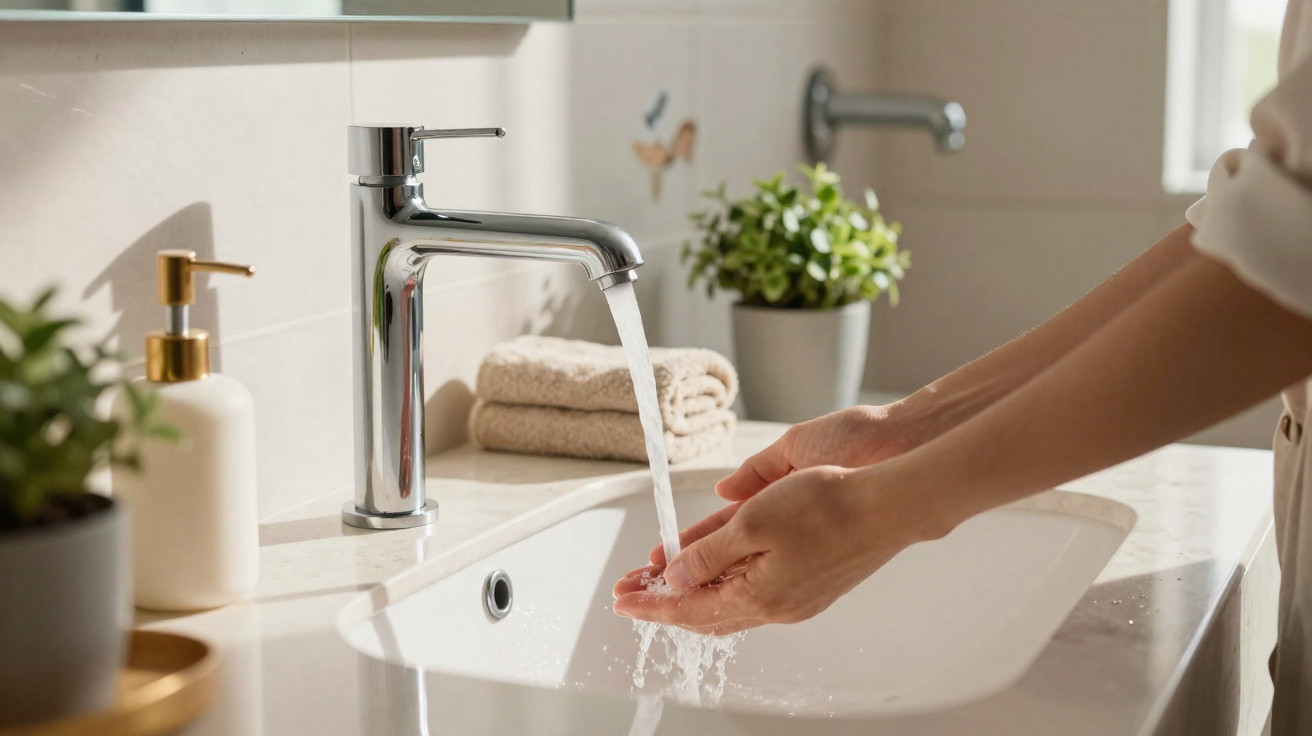
The traditional wall-mounted tap is increasingly being replaced by brassware with cleaner lines, more comfortable operation, and better coordination with the basin, worktop and lighting. In 2026, the strongest bathroom choices are single-lever mixer taps fitted to the worktop, high spouts for countertop basins, and models with sensors or timed operation.
Why does the traditional wall-mounted tap feel less current?
A traditional wall-mounted tap does free up the worktop, but it depends on precise alignment with the basin and can make future layout changes harder. When the piece has an older profile, an exposed valve, and a standard chrome finish, the bathroom can end up looking more dated.
Current interiors aim for taps that read as part of the overall scheme. Finishes such as matte black, brushed nickel, soft gold and graphite make it easier to link the tap with the mirror, handles, waste and accessories-without relying on lots of decorative extras.
How does a single-lever mixer tap on the worktop change everyday use?
A single-lever mixer tap on the worktop replaces two separate valves with one lever. That makes day-to-day use quicker, simplifies temperature adjustment when hot water is available, and reduces the number of visible parts around the basin.
- Works well on compact worktops, as long as there is space between the basin and the wall.
- Suits inset basins, semi-recessed basins and carved/formed basin styles.
- Lets you change the finish without having to redo the whole bathroom.
- Requires the water supply point under the worktop, or a short adaptation from the existing set-up.
When should you choose a high spout for a countertop basin?
High spouts have become more popular because they complement countertop basins, which act as a visual feature in the bathroom. They create a smart vertical line, enhance the worktop, and help prevent water from landing too close to the rim of the basin.
The key is proportion. In small bathrooms, a high spout should have a slim design and a well-positioned outlet to reduce splashing. In a cloakroom, it tends to work especially well because usage is lighter and the overall look can be more striking.
Why are sensor taps and timed taps becoming more popular?
Sensor models and timed-operation taps offer convenience and water savings. They stop the tap being left running while someone soaps their hands, and they reduce direct contact with the fitting-particularly helpful in shared bathrooms.
- Sensor: starts water flow when hands approach, and keeps the worktop looking cleaner and less cluttered.
- Timed: releases water for a few seconds and then shuts off automatically.
- Worktop-mounted: is usually easier to adapt when there is already a hole in the basin or worktop.
- Battery-powered: avoids major electrical changes in many residential models.
How to follow the trend without refurbishing the entire bathroom
Before replacing a traditional wall-mounted tap, check where the water feed comes from, the height of the basin, and how much clear space you have above the worktop. If there is already a supply point under the top, a worktop-mounted tap is the most straightforward swap. If the feed is in the wall, a slimmer concealed version can modernise the look with less disruption.
The best outcome comes from matching the tap to the room’s proportions: a low single-lever mixer for small worktops, a high spout for a countertop basin, and a sensor tap for frequently used cloakrooms. That way, changing the brassware updates how the space reads-without forcing you to replace tiles, the worktop, or the entire plumbing installation.





Comments
No comments yet. Be the first to comment!
Leave a Comment