
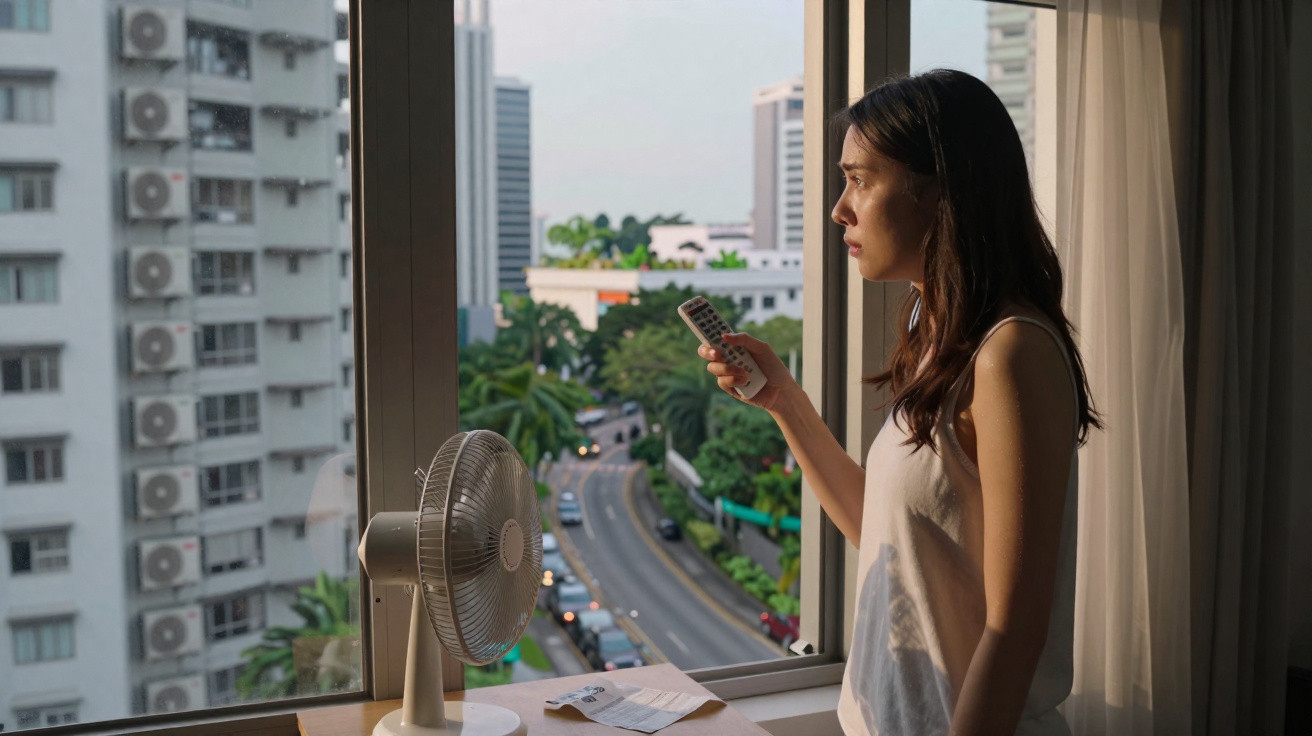
Air conditioning has become a necessity during severe heatwaves. It helps people do their jobs safely, enables children to sleep in comfort, and shields older adults from hazardous heat stress.
Across many tropical cities, air conditioning is no longer viewed as a luxury item. It has become a basic means of coping.
Yet there is a downside. As more people depend on private cooling to avoid higher temperatures, they may be less inclined to back broader changes that could cool whole neighbourhoods.
That unease sits at the centre of new research from Singapore, where scientists suggest that air-conditioning may be subtly reshaping how people react to the climate pressures around them.
Human behaviour limits climate action
The challenge is about more than personal comfort. Due to climate change, cities worldwide are warming rapidly.
On top of that sits the urban heat island effect – where concrete, asphalt and densely built-up areas store heat and continue to radiate it long after the sun goes down.
In some places, nights barely cool at all. In turn, widespread air-conditioner use releases additional heat into the surrounding atmosphere.
Researchers at the Singapore University of Technology and Design, together with the Singapore-ETH Centre, describe this dynamic as “behavioral insulation.”
In essence, when people can protect themselves from heat indoors, the motivation to support wider public remedies can begin to ebb.
Air-conditioning use is increasing
To investigate, the team examined survey data from 967 adults living in 416 households in Singapore. They also looked at household electricity consumption and local heat conditions across different neighbourhoods.
Their results pointed to a gap between awareness and follow-through.
Respondents who felt the heat most intensely were more likely to discuss climate issues and urge others to take them seriously. However, that heightened concern seldom showed up as reduced household energy use.
Homes that depended heavily on air-conditioning consumed more electricity and were less likely to take up energy-saving routines.
“One of the key findings is that experiencing heat does not automatically translate into lower-energy behaviour or stronger collective climate action,” said Dr. Natalia Borzino, lead author of the study.
“People may become more climate-aware and more vocal about heat, while still relying heavily on energy-intensive cooling to manage daily life.”
This matters because the global appetite for cooling is rising.
The International Energy Agency (IEA) cautions that air conditioning could become one of the largest contributors to increasing energy demand over the coming decades.
The strongest growth is expected in Asia, Africa and the Middle East.
As incomes increase and living standards improve, millions of households are buying air conditioners for the first time.
The problem outside the front door
Singapore provided a particularly useful setting to explore this question. The city-state is compact, humid, highly urbanised and extensively air-conditioned.
In many ways, it may foreshadow what other warming cities could soon experience.
The study found that electricity use was higher in hotter neighbourhoods largely because residents ran more cooling.
Air conditioning emerged as the central connection between intensifying urban heat and growing energy demand.
High levels of cooling use also reduced support for public measures intended to lower outdoor temperatures, such as planting trees, creating shaded walkways and making neighbourhoods greener.
Meanwhile, many households still showed a readiness to spend more money to improve comfort indoors.
Caught in a vicious cycle
This sets up an awkward feedback loop. As cities heat up, residents increasingly turn to private cooling.
And the more effectively private cooling eases daily discomfort, the less urgency people may feel to campaign for larger, community-wide remedies.
“Heat is not just a temperature challenge. It is also a behavioural and planning challenge,” said Professor Samuel Chng.
“If cities rely too heavily on private cooling, they risk locking in higher energy demand while weakening the collective support needed for wider urban heat solutions.”
Cooling cities instead of just buildings
The researchers do not portray air-conditioning as the villain. In tropical climates, cooling supports health and wellbeing. During extreme heat, it can be lifesaving.
Even so, the paper argues that cities cannot depend on air-conditioning as the sole solution.
Urban planners have long recognised that shade, trees, ventilation, reflective building materials and better street layouts can bring down temperatures across whole neighbourhoods.
Green roofs and parks can lower surface heat. Improved airflow between buildings can stop heat becoming trapped.
Even roads and roofs in lighter colours can reflect sunlight rather than soaking it up.
Individual adaptation and collective resilience
These approaches work in a different way to air conditioning. Rather than cooling one flat at a time, they reduce heat exposure outdoors for everyone.
“This research shows that adaptation is not just a technical or infrastructural issue. It is fundamentally social and behavioral,” said Dr. Harvey Neo.
“The challenge for cities is to design systems where individual adaptation and collective resilience reinforce each other, rather than move in opposite directions.”
A warning for growing cities
Many cities still have limited access to air-conditioning today, but that picture is shifting quickly.
As temperatures climb and cooling technology becomes more affordable, billions of people are expected to purchase air-conditioners over the next few decades.
Places already contending with punishing summer heat are recording peak electricity demand during the hottest months. In some regions, power grids are struggling to keep pace.
The Singapore findings indicate that the discussion about cooling needs to extend beyond appliances alone.
Protecting people during extreme heat is essential. But so is building cities where residents are less exposed to dangerous temperatures in the first place.
Otherwise, the years ahead could bring more air-conditioners, greater energy consumption, hotter streets and weaker public backing for the kinds of upgrades that could make urban life more liveable for everyone.
The full study was published in the journal Sustainable Cities and Society.






Comments
No comments yet. Be the first to comment!
Leave a Comment