
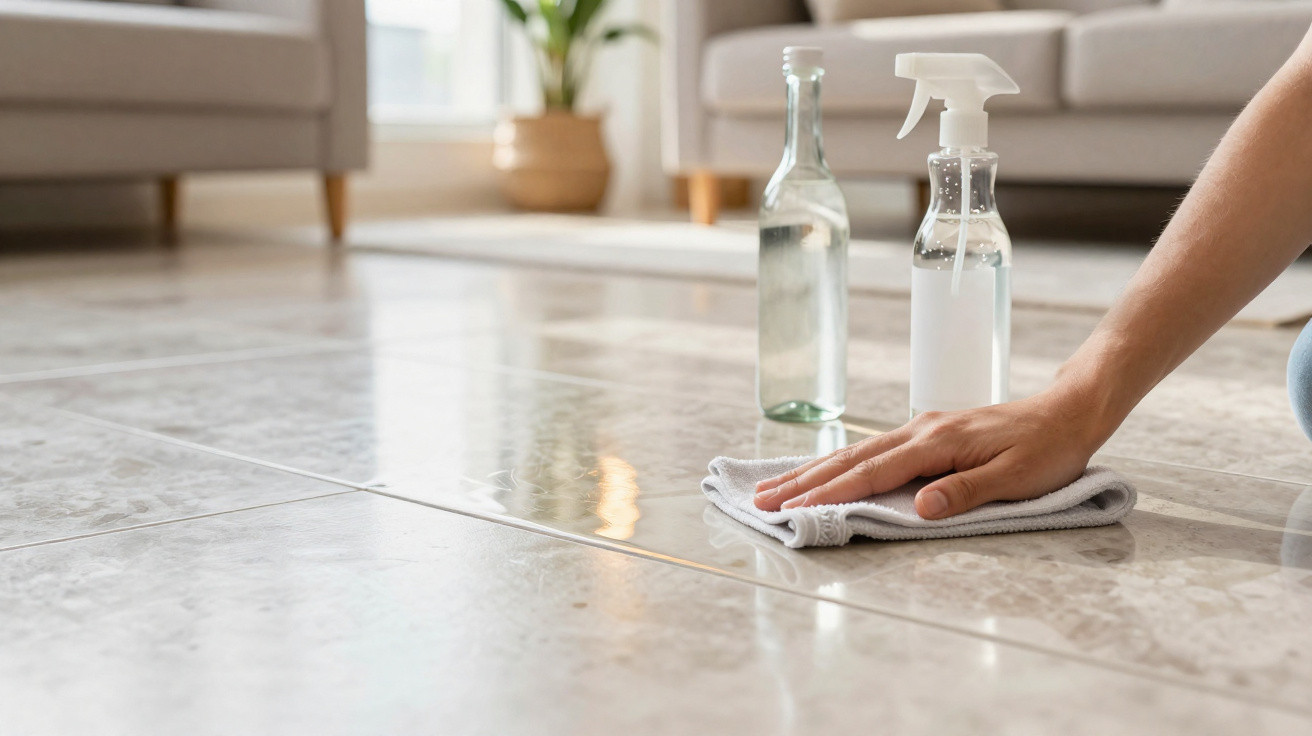
The problem is rarely the mop.
Porcelain stoneware or ceramic tiles in kitchens and living rooms are often seen as tough and easy to maintain. In practice, after a few years they frequently develop smears, footprints and a permanently dull haze - even in homes where the floor is mopped regularly. Instead of shine you get frustration, and before long people start tipping all sorts into the bucket: lemon, powders, fragranced cleaners, and random combinations. Professionals in commercial cleaning advise against this and rely on one single, very straightforward product from the kitchen cupboard.
Why lemon and powders do more harm than good on tiles
Online, you’ll find countless home-remedy suggestions for dull tiles: a splash of lemon juice in the bucket, a spoonful of powder, or a bit of everything together. It can look harmless, smell fresh and seem as if it must be cleaning thoroughly - but specialists view it far more critically.
Porcelain stoneware may be hard-wearing, yet the glazed layer can be sensitive to two things: strong acids and abrasive particles. Too much citric acid or an overgenerous amount of powder cleaner can gradually wear away that surface. As a result, the tiles lose their factory sheen, become slightly rougher, and then attract dirt more readily. Each subsequent mop can make the floor look worse, not better.
There’s also a second issue: when multiple home remedies are combined - for example different powders and acids - a fine residue often remains. It tends to show up as:
- a milky haze across the whole floor
- streaky lines visible in reflected light
- tacky-feeling patches that seem to attract dust
That’s the opposite of what you were aiming for. Rather than looking polished, the floor can appear permanently unclean - even straight after mopping.
"Professionals advise: fewer mixtures, clearer products, and no experiments with strongly acidic or abrasive ingredients on porcelain stoneware."
The underestimated cupboard staple: why clear vinegar is a game-changer here
Cleaning firms with decades of experience in hotels, offices and public buildings often recommend a solution for dull porcelain stoneware floors that most people already have at home: colourless clear vinegar with no additives. When diluted correctly, it delivers three benefits that help bring back shine:
- It breaks down grease and dried-on kitchen residue.
- It neutralises many limescale deposits and detergent build-up that cause streaks.
- It evaporates without leaving residue, as long as you don’t overdo the concentration.
The key point from the pros is the dilution. Pouring neat vinegar onto grout lines or effectively soaking the floor in it can produce the reverse of the desired result.
The recommended mix for glossy porcelain stoneware
For a typical kitchen or living room floor that’s only slightly dulled, specialists suggest this simple base ratio:
- 1 part colourless clear vinegar
- 3 parts warm water
Put the solution into a bucket used only for floors. Then use the right tool: a microfibre mop or cloth. Cotton rags or old T-shirts often spread moisture unevenly and simply push dirt around.
"What matters isn’t only how much vinegar you use, but the technique: apply evenly, rinse clearly, dry thoroughly."
Step by step: how professionals do it
- Remove dust and crumbs: Vacuum or sweep first; otherwise every grain can rub across the surface like sandpaper.
- Mix the vinegar solution: Pour warm water into the bucket, add the correct share of vinegar, and stir briefly.
- Wring out the microfibre well: The cloth should be damp, not dripping. Too much water quickly leaves puddles and marks.
- Mop methodically: Work in steady strips rather than randomly criss-crossing, so the solution spreads evenly.
- Follow with clean water: Go over the floor again using a second clean cloth and plain water to lift any remaining acidity.
- Dry by hand: Buff with dry microfibre or a soft cloth. This is what brings out the shine and prevents drying edges.
After just one pass the floor often looks noticeably fresher. If you’ve previously relied on heavily fragranced cleaners or powders, this is often the moment you realise how much old film has built up over the years.
A gentle routine: keeping porcelain stoneware floors looking good long term
For day-to-day cleaning, experts recommend keeping things mild. More chemicals or more fragrance doesn’t automatically mean a cleaner floor. A mix of warm water and a neutral floor cleaner is usually advised. Ideally the pH should sit in the neutral range - neither strongly acidic nor strongly alkaline.
A few basic habits help preserve the original finish for as long as possible:
- Mop regularly, but don’t overdo it: Remove heavy dirt promptly, but a full daily clean is rarely necessary.
- Never overdose: Doubling the amount of cleaner often just doubles the streaks.
- Always dry: Air-drying can leave marks quickly, particularly in hard-water areas.
Stubborn marks: treat the spot, not the entire home
If only certain areas stand out, professionals don’t reach straight for a harsh specialist cleaner across the whole floor. Instead, they target the affected section only:
- Greasy kitchen spots: Apply a small amount of powder directly to the area, gently rub in circles with a soft brush, then rinse away thoroughly with water.
- Rust marks from furniture or appliances: Apply a thicker vinegar paste made from a little water and powder, leave for around 15 minutes, then rinse off without aggressive scrubbing.
This spot-treatment approach stops the entire floor from being exposed to abrasive particles. That helps protect the glaze and keeps the shine for longer.
Protection rather than repair: how to avoid losing shine again
Once you’ve put in the effort to revive a dull floor, you won’t want to repeat the process every couple of months. That’s why professionals focus heavily on prevention - because much of the loss of shine happens before you even start mopping, simply from walking across the room.
Useful measures include:
- High-quality doormats at entrances: They catch sand and tiny stones that otherwise act like sandpaper.
- Felt pads under furniture: These reduce micro-scratches when chairs and tables are moved.
- No harsh scouring pads: The classic green-and-yellow kitchen scourers don’t belong on glazed porcelain stoneware.
If you want to give the floor an occasional visual “boost”, do it sparingly: a very thin layer of a natural oil such as olive oil, or a beeswax product, worked in thoroughly with a soft cloth, can create a refined sheen for a few days. The crucial point is to use only a barely-there amount and buff it in properly, so nothing is left greasy.
What actually causes streaks, shine and that “dull haze”
Many households underestimate how much water quality and cleaning habits shape how a floor looks. Hard tap water dries with limescale edges, and strongly fragranced cleaners often leave surfactant residues. Together, they create the familiar dull film - which typically only lifts again with a clear, mildly acidic solution.
Porcelain stoneware itself doesn’t simply fade. In most cases, the apparent greying comes from layers sitting on top: old polymers from “shine” cleaners, limescale, grease and dust. If you occasionally dissolve those layers in a controlled way using diluted clear vinegar, and then return to a mild routine, you can recover a surprising amount of the original look.
Ultimately, it’s not a “miracle product” from an advert that decides the result, but a combination of restrained product choice, precise mixing ratios, and one final step many people skip: drying by hand. That last pass with a dry microfibre cloth is what separates “just mopped” from “looks like new”.



Comments
No comments yet. Be the first to comment!
Leave a Comment