
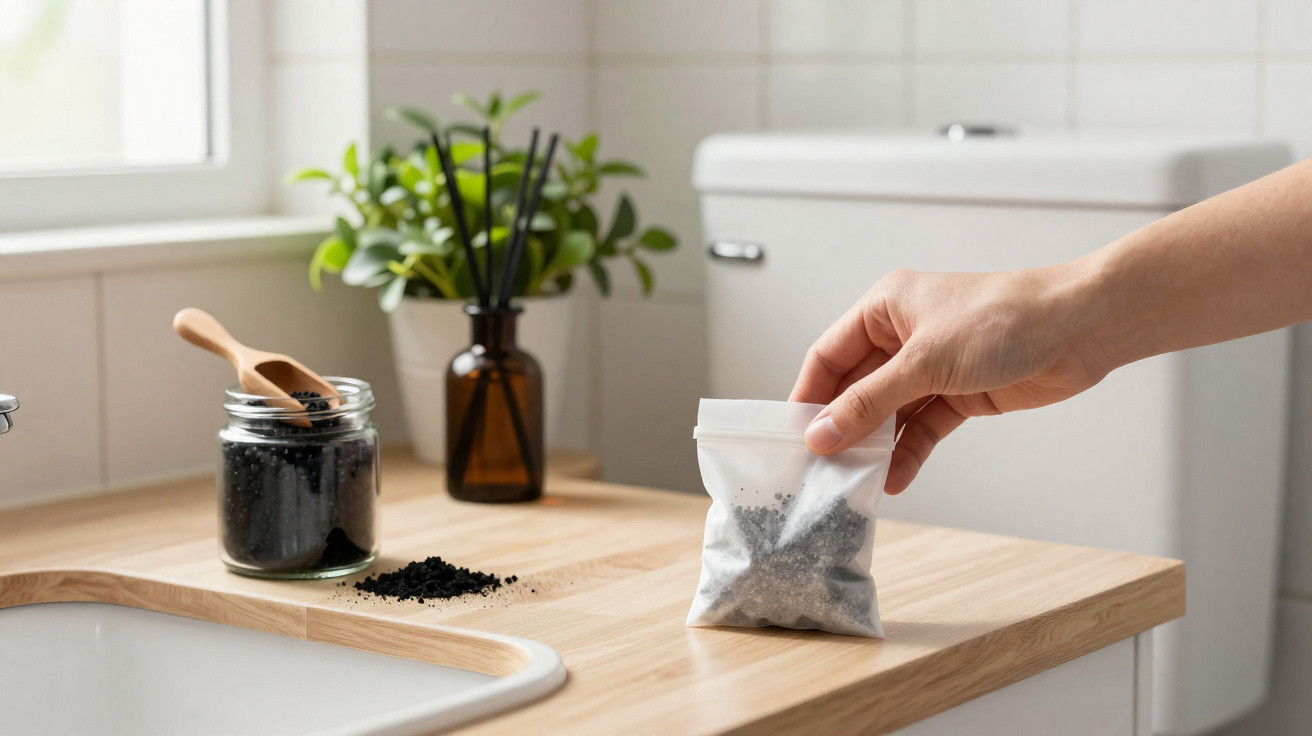
Activated charcoal in the bathroom has become a go-to option for people who want to cut down unpleasant smells without relying on heavy air fresheners. Unlike scented sprays, it does not try to mask odours with a strong fragrance. Instead, it helps trap some of the molecules that cause bad smells-especially in compact bathrooms, windowless cloakrooms and spaces with limited airflow.
What is activated charcoal in the bathroom used for?
Activated charcoal is used to help manage mild, lingering odours. You can place it in sachets, ventilated jars or purpose-made pouches, keeping it dry and out of reach of children and pets. The key is to leave the charcoal exposed to the air so it can come into contact with odour molecules.
In bathrooms, it is often useful near the bin, behind the toilet, inside closed cupboards, or close to drains that develop a faint smell between cleans. The result is subtle-no artificial perfume-and it tends to work best as a way to maintain a space that is already clean.
Why does it help with odours?
Activated charcoal goes through a treatment that greatly increases its porosity. Those tiny pores create a very large surface area, which can hold onto particles and volatile compounds on the surface. This is called adsorption (with a “d”), because the molecules stick to the material.
- Helps reduce that “stale” smell in a closed room.
- Does not fill the bathroom with a strong perfume.
- Can be used in windowless cloakrooms.
- Works well inside ventilated cupboards.
- Useful near small bins and dry drains.
Even so, it will not fix the underlying cause of a persistent bad smell. If the odour is coming from the sewer, poor seals, a dry trap, mould, or inadequate cleaning, charcoal only softens the problem for a short time. In those situations, you need to deal with the source.
How to use it without making a mess
For home use, the most practical options are sachets of granulated activated charcoal or charcoal sticks. Loose powder can stain grout, fabric, pale worktops and porous flooring. For that reason, it is not a good idea to sprinkle it directly on the basin area, into the toilet, or onto the floor.
- Use breathable fabric sachets or containers with holes.
- Keep it away from direct water from the shower or basin.
- Do not pour activated charcoal into the toilet or down the drain.
- Replace or reactivate it according to the manufacturer’s guidance.
- Keep it away from damp towels to avoid black residue.
Some sachets can be left in the sun for a few hours to reduce moisture and restore some of their effectiveness. Not every product supports this, so you should follow the instructions on the packaging.
Where to put it for the best results
Placement matters. The charcoal needs airflow-it will not do much if it is tucked away in a sealed container. In a cloakroom, it can sit neatly on a shelf. In larger bathrooms, it is often better to spread two small units around the room rather than keeping everything in one corner.
A minimum level of ventilation also helps. Opening a window after a shower, switching on an extractor fan, and leaving the door ajar when you can all reduce humidity. Activated charcoal performs better when it is not battling constant steam, active mould and an overflowing bin.
This odour-fighting helper works best alongside cleaning
Activated charcoal can be helpful because it works quietly in the background, but it is not a replacement for cleaning. The toilet, drains, bin, shower area, towels and bath mats are still the places most likely to hold on to smells. When those items are kept clean and dry, a sachet can do its job more effectively.
To keep the bathroom smelling fresh, the most effective combination is straightforward: daily ventilation, water in the trap, a lidded bin, dry towels, and activated charcoal kept in a well-ventilated spot. That way, odours are managed without overpowering perfume-and without turning a simple household trick into extra mess during cleaning.

Comments
No comments yet. Be the first to comment!
Leave a Comment