
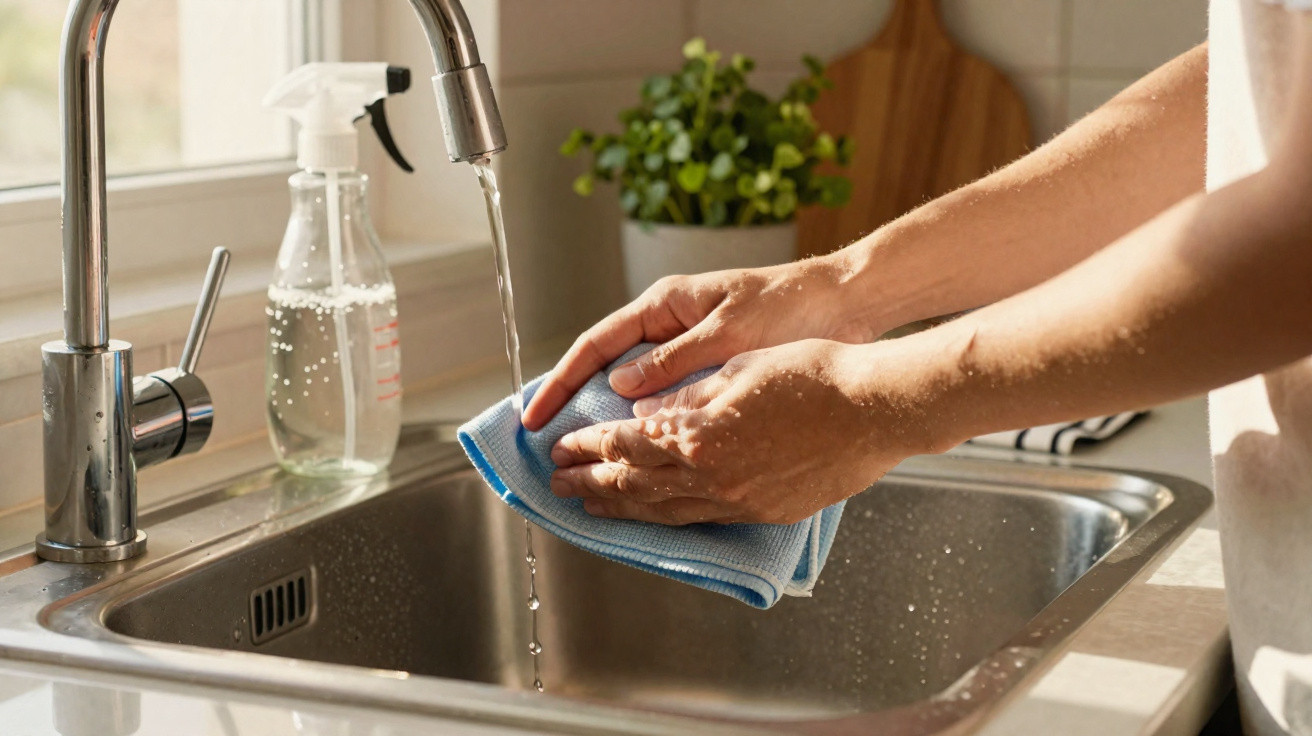
You wipe, it streaks. You rinse, and the marks come straight back. It isn’t ordinary dirt, not exactly-it’s chemistry leaving a signature on your fittings. And it happens everywhere, from compact studio flats to spotless-looking suburban kitchens.
One morning, the light caught my kitchen at just the wrong angle and the tap looked as if someone had dusted it with chalk. I rinsed a glass, left it to air-dry, and within minutes the sun revealed neat little dots-like a trick you can’t unsee. It looked clean, but it didn’t feel clean. I tried a new sponge, a dab of washing-up liquid, even a quick pass with kitchen roll that only added lint. Then I opened the cupboard and reached for a single bottle. The solution was already sitting there.
Why those stubborn water marks won’t quit
Those marks aren’t grime in the usual sense. They’re mineral deposits-mainly calcium and magnesium-left behind when hard water droplets evaporate on a surface. On glass and chrome they show up as pale rings, cloudy patches, and tiny white specks that catch the light and refuse to disappear. Hard water marks are minerals, not dirt.
Where I am, the kettle develops a white “collar” every couple of weeks, like clockwork. The U.S. Geological Survey estimates that around 85% of American homes have hard water, and plenty of areas across the UK and Europe deal with the same issue. A friend in London told me her shower screen turns hazy within hours, while a cousin in Seattle can go weeks without noticing a single spot. Location determines the mineral mix-your fixtures simply make it visible.
There’s a straightforward reason everyday cleaners often fail here. Soaps and detergents excel at lifting grease, food residue, and typical household mess. Minerals behave differently. Calcium carbonate-the chalky culprit-is alkaline. To break it down, you need a gentle acid that can dissolve the scale so it releases from the surface and wipes away. That’s where the cupboard “hero” comes in: white vinegar. It’s roughly a 5% acetic acid solution, and it reacts with the deposit to reveal the shine underneath.
The pantry fix: white vinegar, step by step
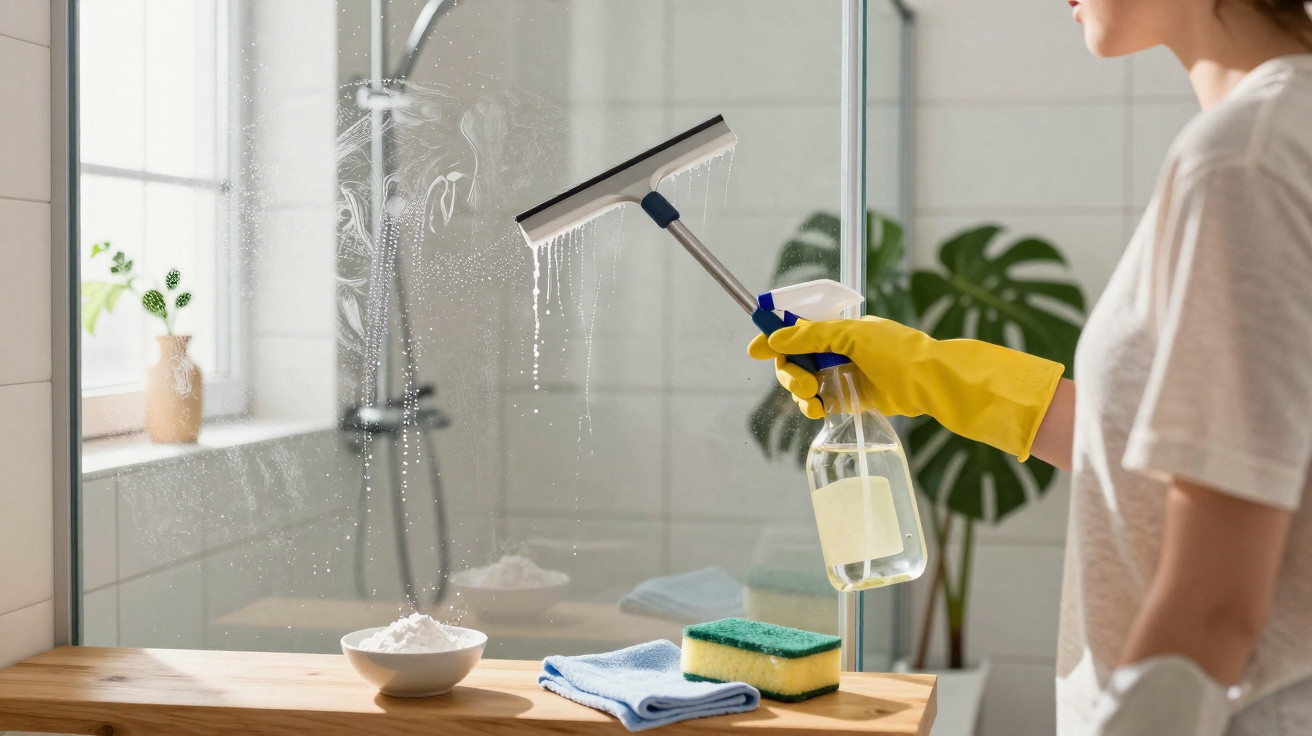
Start with distilled white vinegar and a clean spray bottle. For regular spotting, mix equal parts warm water and white vinegar (a 1:1 solution). For heavier limescale, use neat vinegar.
Spray the marks until the surface is evenly wet, then leave it to sit. Give the acid a few minutes to do the hard work. After that, wipe with a microfibre cloth, rinse with clean water, and buff dry for a clear, glossy finish.
For taps, soak a piece of kitchen roll in vinegar and wrap it around the spout for 10 minutes. Remove it, then wipe and polish. White vinegar is the simplest, cheapest fix most homes already own.
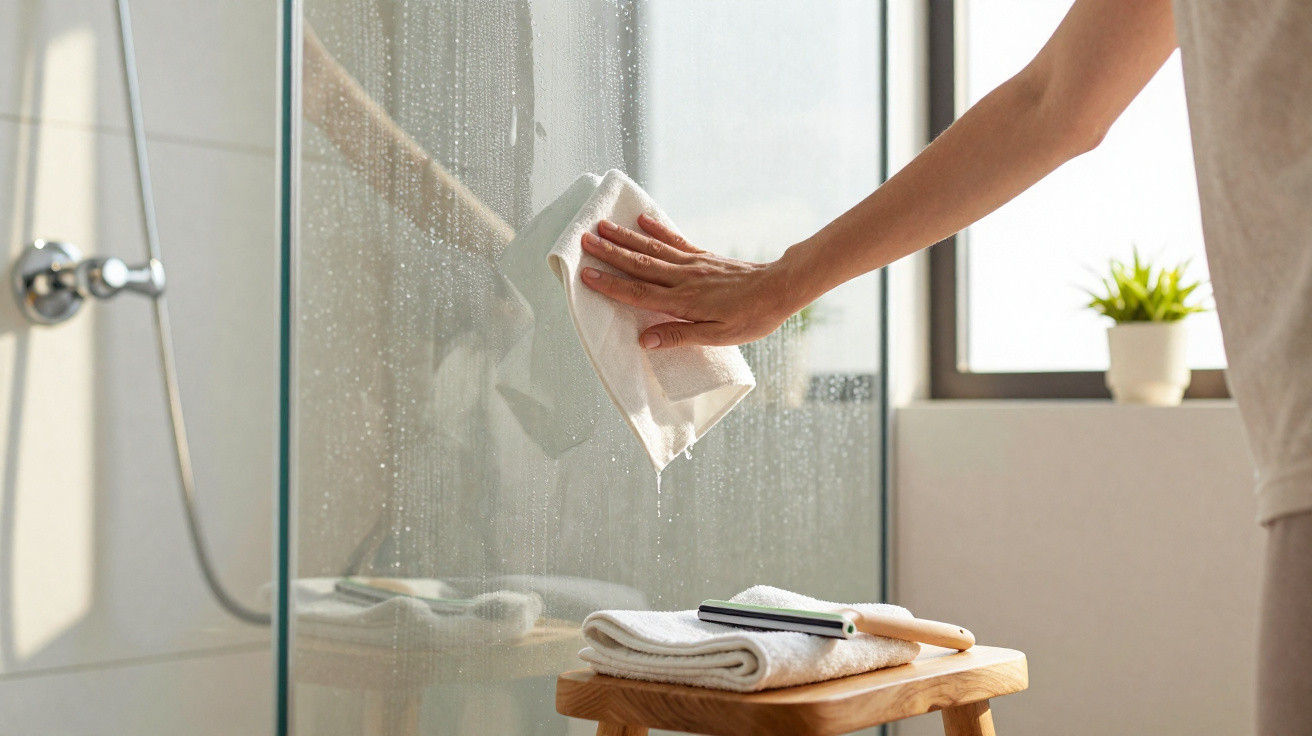
Small tweaks make the process easier. Warm vinegar works more quickly than cold. On vertical surfaces (such as shower glass), spray first, then press a damp cloth soaked in vinegar against the pane so the liquid doesn’t just run off. If the build-up is stubborn, a second application is usually more effective than aggressive scrubbing. Swap kitchen roll for microfibre to avoid that “lint confetti” effect. And let’s be realistic: nobody keeps up with perfect daily maintenance. When you miss a day (or ten), it’s better to rely on dwell time than on elbow grease.
Keep the approach “gentle acid, calm hands”. Avoid abrasive pads that scratch-scratches give minerals more places to cling next time. Never mix vinegar with bleach; the combination can create dangerous fumes. And go carefully with the vinegar-and-bicarbonate-of-soda duo: the fizz looks impressive, but it neutralises the acid and reduces cleaning power. Use them one after the other, not at the same time.
“Acid does the work. Dwell time is your friend; scrubbing is the encore,” a veteran appliance tech told me while we watched a faucet go from spotted to mirror-bright.
- Safe bets: glass, chrome, stainless steel, ceramic tile, most plastics.
- Use caution: aluminium (brief contact only), rubber gaskets (don’t soak), painted finishes.
- Avoid: marble, limestone, travertine, onyx-any calcareous stone that vinegar can etch.
Takeaways you can try today
Begin with a small target: the bathroom tap, the dishwasher door, or the limescale line inside the kettle. Use warm white vinegar as a spray or soak, wait, wipe, rinse, then buff dry.
If you’re tackling a glass shower door, pair the vinegar step with a quick daily squeegee to stop new droplets drying into fresh marks. In the dishwasher, consider using a rinse aid to reduce glass cloudiness.
Most of us know the feeling: the sink looks brilliant at night, and by lunchtime it’s speckled again. Reaching for a cupboard bottle feels almost too easy-but the shine is real. Tell the person convinced they need a specialist product. Chances are they already bought the answer-next to the crisps-for a fraction of the price.
| Key point | Detail | Why it matters to you |
|---|---|---|
| Vinegar breaks mineral bonds | Acetic acid dissolves calcium deposits left by hard water | Removes spots quickly without harsh scrubbing |
| Method matters | Spray, wait 3–10 minutes, wipe, rinse, buff dry | Delivers a streak-free finish on glass and chrome |
| Know where not to use it | Avoid natural stone; limit contact on delicate finishes | Protects surfaces and helps prevent expensive damage |
FAQ:
- What’s the cooking ingredient that clears tap water marks? Plain distilled white vinegar. It’s about 5% acetic acid, mild enough for home use yet strong enough to dissolve mineral spots.
- Can I use apple cider vinegar instead? Yes, though it may leave a light scent and a tint. White vinegar is colourless and usually cheaper, which makes it better for glass and fixtures.
- Is vinegar safe on stainless steel faucets? Yes for short contact. Spray or wipe, wait a few minutes, then rinse and dry. Don’t soak joints or rubber seals for long periods.
- Will this work on car windows or exterior trim? It can lift spots on glass, but keep vinegar off paint and avoid prolonged contact with rubber seals. Apply to a cloth, not directly, then wipe and dry.
- Why not scrub hard or use abrasive pads? Scratches trap future minerals and make spotting worse. Let the vinegar sit, then wipe with microfiber. If needed, repeat the soak rather than grind.

Comments
No comments yet. Be the first to comment!
Leave a Comment