
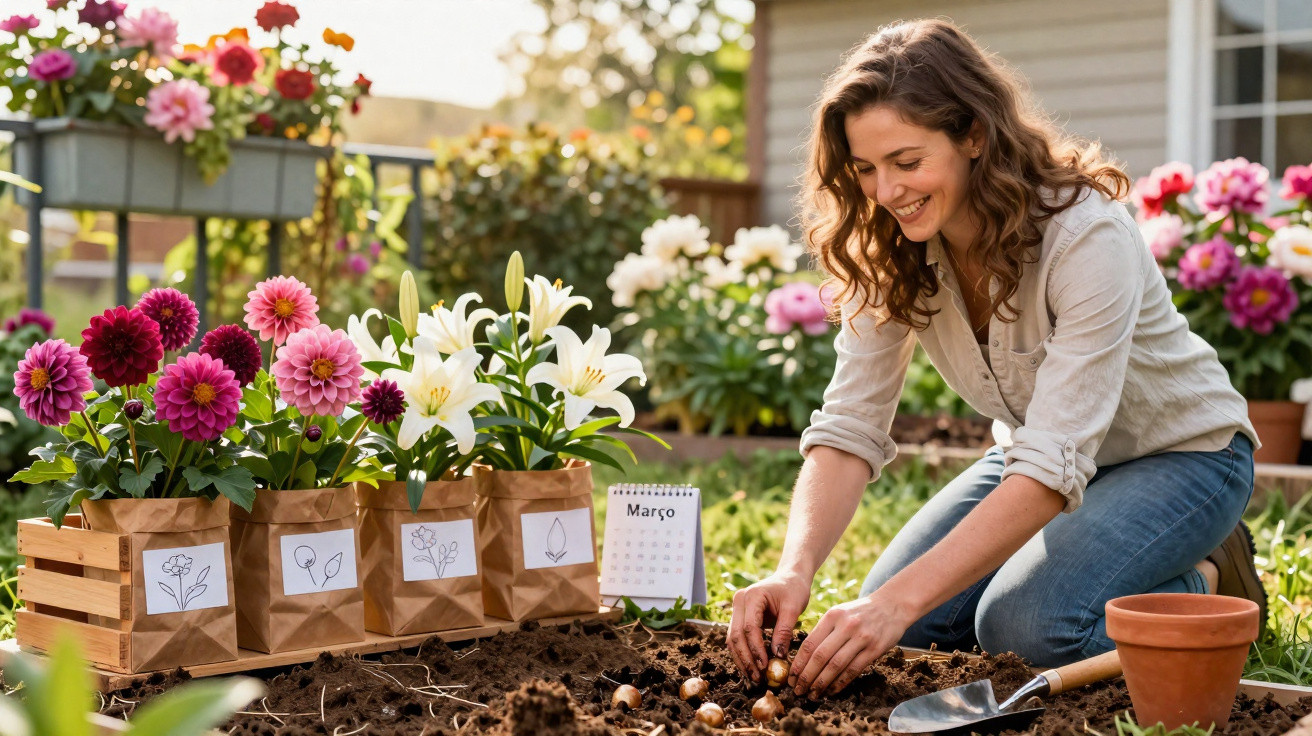
With four carefully chosen bulb and tuber plants, you can stop that happening.
Once daffodils and tulips have finished, many gardens can suddenly feel as though someone has switched them off. For weeks, it can look as if nothing is going on at all, until roses, perennials and summer bedding finally get moving. You can actively avoid this dull in-between spell - as long as you put the right bulbs and tubers in the ground in March.
Why March determines whether the coming weeks are colourful or bleak
As the soil starts to warm up and the worst hard frosts are usually over, beds can still look bare. This is exactly the moment when summer-flowering bulbs and tubers should go in. If you leave it until the end of April, flowering often shifts into high summer. The result is a long, quiet stretch after spring even though the weather is already calling for time outdoors.
"Planting in March often brings flowering forward by four to six weeks - filling the gap between spring and midsummer."
Four well-known favourites work particularly well together: dahlias, begonias, lilies and peonies. They flower at different times, prefer different positions, and keep the garden changing for months.
Four planting stars for gap-free flowering
Dahlias: a firework of colour from June to October
For many gardeners, dahlias are the unofficial kings of late summer. If you gently wake the tubers in March, you’ll often be rewarded with the first blooms as early as June.
A good method is:
- Check tubers and cut away any soft or rotten parts
- Lay them shallowly in pots with loose compost, covering the tubers only lightly
- Keep them bright and frost-free, evenly moist but never waterlogged
- From May, after the risk of frost has passed, plant out into borders or large containers
Dahlias prefer a sunny to partially shaded spot and nutrient-rich, free-draining soil. You can choose everything from small pompon flowers to large cactus-like forms, which makes them suitable for cottage-style planting as well as modern, clean-lined schemes.
"Dahlias bridge the gap after the spring bloomers and often keep going until the first frost - hardly any other garden plant flowers for so long."
Begonias: splashes of colour for shade and a north-facing balcony
Where roses struggle and geraniums sulk, begonias tend to thrive: in partial shade to shade, on the north side of the house, beneath lightly canopied trees, or on balconies without direct midday sun.
In March, set the tubers in shallow trays or pots. Position them with the rounded side down and the slightly hollowed side facing up, then cover only lightly with compost. The compost should be open and humus-rich, and it should stay gently moist at all times without standing water.
A few rules of thumb make care easier:
- Plenty of light but no frost - 15 to 18 °C indoors or in a greenhouse is ideal
- Water regularly but sparingly; never leave tubers sitting in water
- From mid-May, move outside and acclimatise gradually to outdoor conditions
- Remove spent flowers to encourage fresh buds
Begonias flower throughout the summer in white, pink, red or orange, and they are impressively low-maintenance. In autumn, the tubers go back indoors and can be reused for several years.
Lilies: elegant height and fragrance in summer borders
Lilies create strong focal points with tall stems and often scented blooms. They rise above lower perennials, lift the edge of a hedge, and add structure to flower beds.
Plant the bulbs in March at roughly two to three times their own height. A sunny to partially shaded position is fine, but free-draining soil is essential. Waterlogging quickly leads to rot and can cause bulbs to develop fungal problems.
"By choosing lily varieties that flower at different times, you can deliberately bridge the low-flower weeks between spring and full summer."
Some types open in May or June, while others won’t flower until July or August. If you mix timings, you create a staggered display that lasts for months. Another advantage: many lilies can stay in the border and return year after year, provided the site suits them.
Peonies: an investment in dream springs to come
Peonies usually won’t make a big impact in the first season, but they are a long-term savings account for flowers. Planting root pieces or young plants in March lays the groundwork for spectacular springs for decades ahead.
These perennials are tough, cope with many soil types and can remain in the same place for years. The key point is depth: don’t plant them too deep. With herbaceous peonies, the buds should sit no more than 3 to 5 cm below the surface. Planting too deeply is the most common reason they fail to flower.
Peonies also require patience. Often, they only show their full potential after two to three years. If you plant now, you gain a long-lived, easy-care flowering perennial that becomes more reliable each year.
How to stretch flowering in the garden over months
To avoid a flowerless period, it helps to sketch a rough plan for the gardening year. Even on their own, the four bulb and tuber groups above cover a surprising number of weeks.
| Plant | Planting time (March) | Expected flowering |
|---|---|---|
| Dahlia | Start tubers into growth in pots | June to October |
| Begonia | Tubers in pots or shallow trays | June to September |
| Lily | Bulbs directly into the border | May to August (depending on variety) |
| Peony | Young plants or root pieces | from year 2–3, May to June |
By combining these four groups, you can close the gap between spring bulbs, summer perennials and late-season flowers very effectively. As an extra option, you can also plant classics such as gladioli, crocosmia or ornamental alliums, which go into the ground in March or a little later.
Practical tips to prevent frost damage and stalled growth
March can bring bright, mild days, but it can just as easily surprise you with overnight frosts. Plants that have been started into growth are particularly vulnerable. A few straightforward steps protect what you’ve planted:
- Bring pre-started pots indoors or into the garage overnight
- In borders, cover young shoots with horticultural fleece or inverted terracotta pots
- On heavy soils, work in sand or fine grit to reduce wetness
- Don’t feed too early, otherwise shoots can become soft and frost-sensitive
If your garden is in an exposed spot, you can delay planting tender varieties until April - but you should expect later flowering. A mixed approach often makes sense: plant some early and some slightly later to spread the risk.
Why gardens without a gap feel calmer
A garden that flowers without long pauses doesn’t necessarily look louder - it simply feels more coherent. Brief changes of colour are easy on the eye, while long stretches without flowers are more likely to seem drab. This is where bulbs and tubers planted in March do their work: they link the seasons together instead of leaving them as separate chapters.
Planting in March also has a practical benefit. Beds have not yet filled out, gaps are easy to spot, and the soil is generally simpler to work. If you decide now where tall lilies or bushy dahlias will go, you can also think ahead about sightlines, shade, and the view from your favourite seat on the patio.
If you’re new to gardening, starting small is worthwhile: a balcony box of begonias, a few dahlias in a pot, two lilies tucked in among the roses. Once you see how much a handful of well-placed plantings can change the feel of the whole garden, March quickly becomes a fixed date in the gardening calendar.





Comments
No comments yet. Be the first to comment!
Leave a Comment