
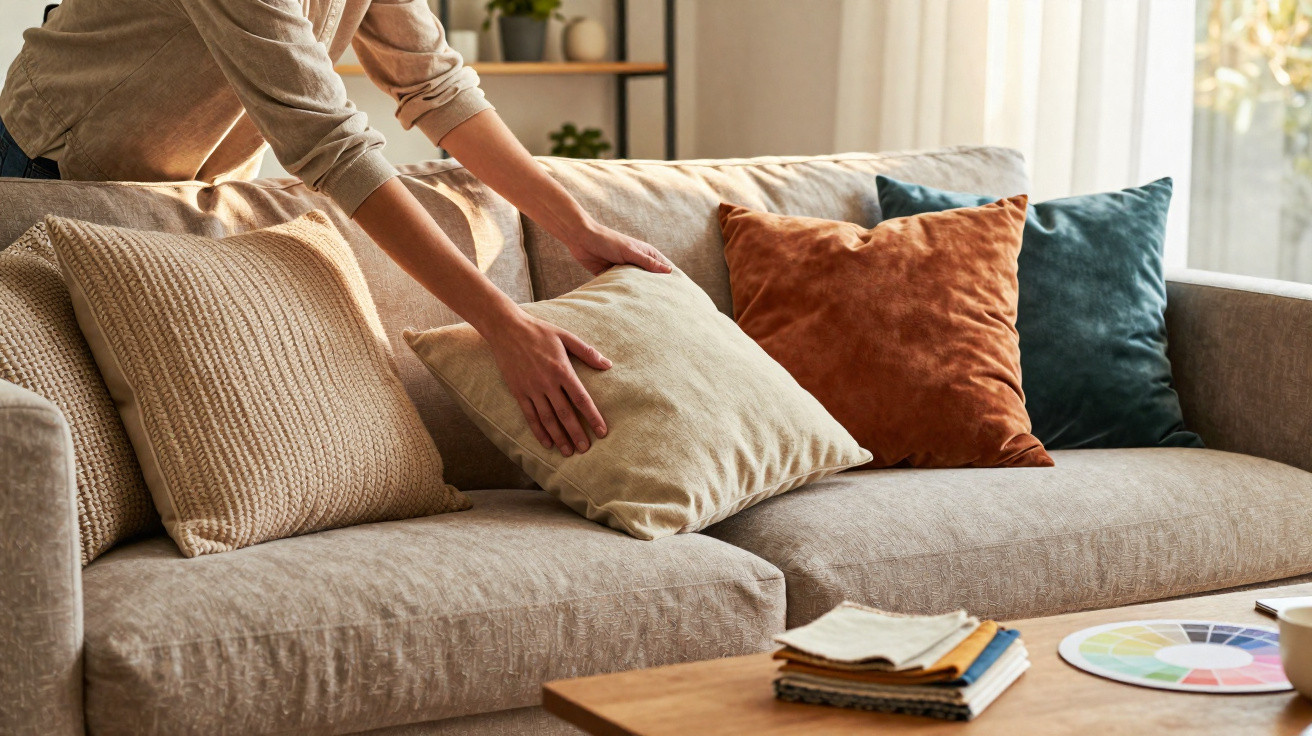
With one simple rule, everything suddenly looks like it belongs in an interiors magazine.
Plenty of people spend good money on a high-quality, comfortable classic sofa - and still feel disappointed. Somehow the area looks unfinished, a bit frantic, or just plain dull. The fabric is luxurious and the colours are, in theory, lovely, yet the overall effect swings between chaos and blandness. A straightforward, almost mathematical styling formula closes that gap: the 3-2-1 rule for cushions.
Why so many sofas still look unfinished - even with lovely cushions
When a seating area feels “bare” or boring, the most common response is to buy more. One extra cushion here, a trendy print there, perhaps a bargain picked up on impulse. Little by little, it turns into a colourful assortment with no real plan.
The issue is rarely the cushions’ quality - it’s the way they’re combined. Colours, patterns and sizes compete instead of working together. Instead of calm, you get visual noise.
“If you simply pile up cushions, you quickly end up with a restless-looking sofa that feels more like a leftovers box than a designed feature.”
The opposite mistake is just as common: worried about it being “too much”, people line up three identical cushions. It’s neat, but stiff - no character, no tension. That’s exactly where a small pro rule comes in, adding structure without another shopping trip.
The 3-2-1 rule: how interior designers think about cushions
The 3-2-1 rule creates a clear hierarchy and makes it obvious which type of cushion does what. It works on sofas, but just as well on beds, window seats or a reading nook.
The formula is:
- 3 plain cushions as the calm foundation
- 2 patterned cushions for energy and movement
- 1 bold or highly textured cushion as the statement piece
The three plain cushions take up the most space. Ideally, they echo the sofa’s colour or sit in related neutral shades such as beige, grey, greige or sand. They steady the overall look and form the backdrop for everything else.
The two patterned cushions add interest. Good options include, for example:
- delicate stripes or checks
- graphic prints
- small floral patterns
- subtle ethnic or boho-inspired motifs
The key point: patterns stay in the minority. That keeps the arrangement engaging without tipping into clutter.
The final cushion is the star. It’s allowed to stand out through a distinctive texture or a strong colour: bouclé, chunky wool, thick corduroy, crinkle linen, or a particularly rich tone. That single “special” element provides the accent many living rooms are missing.
“3 cushions create calm, 2 add life, 1 delivers wow - that’s often all a sofa needs.”
Cushions should look layered, not lined up: mix sizes intelligently
Once the 3-2-1 rule is set, the next lever is proportion. If every cushion is the same size, the result quickly becomes rigid - almost bureaucratic.
Real depth comes from mixing formats. A tried-and-tested approach is:
- Large squares (e.g. 60×60 or 65×65 cm) at the back for height
- Medium squares (around 45×45 or 50×50 cm) in front as the core layer
- One small rectangle (e.g. 30×50 cm) at the front for a relaxed, inviting touch
This makes the sofa look softly built up without feeling bulky. The cushions appear to step forward in layers rather than simply sitting side by side.
Textures: without a material mix, even the best colour choice falls flat
Colour on its own is rarely enough. Fabrics communicate a feeling instantly: cool, cosy, refined, rustic. Using at least two different materials brings that interplay to life.
Popular pairings include:
- linen with velvet for relaxed elegance
- cotton with chunky wool for a cosy, Nordic feel
- smooth canvas with bouclé for a modern, lightly luxurious look
“Even fully neutral tones look exciting when linen, velvet and wool show up together.”
If your sofa is very plain, you can deliberately introduce stronger contrast - for instance, a chunky knitted cushion beside a smooth cotton cover. If the sofa fabric is already striking, it’s often better to keep the material choices a little quieter.
Plan colours: the 60-30-10 formula for a cohesive overall look
Alongside the 3-2-1 rule, there’s another design tool professionals use frequently: the 60-30-10 split. It organises the room’s entire colour scheme.
| Percentage | Role | Examples |
|---|---|---|
| 60% | Base colour | Sofa, wall, rug in beige, grey, greige or off-white |
| 30% | Accent colour | warm terracotta, soft sage green, smoky blue |
| 10% | Contrast | deep green, black, dark navy in small doses |
Applied to cushions, that means: the three base cushions sit close to the base colour, the two patterned cushions pick up the accent colour, and the one statement cushion can play in the contrast zone. The sofa corner then naturally connects to the rest of the room.
Let go of symmetry: why a touch of messiness feels so welcoming
Many people arrange cushions like soldiers in formation because they’re afraid of “too much chaos”. The outcome is a sofa you don’t quite want to use, because it looks overly perfect.
A small break in symmetry makes the living room feel more spontaneous and lived-in. Practical ideas include:
- placing the statement cushion on just one side
- on a corner sofa, grouping cushions in the corner rather than spreading them evenly everywhere
- letting a rectangular cushion sit slightly on the slant, which reads like an invitation to lie down
“The look should feel more like ‘just got up’ than ‘showroom, please don’t touch’.”
Common mistakes - and how to fix them in minutes
To use the 3-2-1 rule, you often don’t need to buy anything new. A quick look in cupboards and other rooms is frequently enough.
Typical issues and fast fixes:
- Too many patterns: swap a few patterned covers for plain ones and rebuild three calm base cushions.
- Everything identical: change two covers to textured fabrics and add a smaller rectangle.
- Colour chaos: choose one main colour family, then remove anything that’s far off - or move it to another room.
- Not enough volume: invest in fuller inner pads and stop reusing old, flat inserts.
How to adapt the look to different home trends
The 3-2-1 rule stays the same - only the cushion choices shift depending on the style you want:
- Scandinavian: lots of linen and cotton, light shades, fine stripes, subtle checks
- Boho: macramé details, tassels, ethnic patterns, warm earth tones, ideally one bold patterned cushion
- Modern minimalist: clean lines, fewer but higher-quality cushions with pronounced textures in restrained colours
- Glamorous: velvet, silky sheens, deep forest green or midnight blue, plus a small cushion with a metallic effect
The interesting part is that the underlying rule still holds, even when the style changes. If you only swap covers, you can refresh the living room regularly without touching the sofa itself.
Why small rules like this noticeably change the everyday atmosphere
A well-styled sofa does more than improve photos for social media. A calm but interesting seating area affects how easily you unwind in the evening, how keen you are to host guests, and how tidy a room feels - even if there’s still a stack of magazines on the coffee table.
The 3-2-1 rule removes the uncertainty from styling decisions. Instead of buying new things at random, you can get more out of what you already own with a few targeted tweaks. Once you understand how number ratios, textures and colours support each other, you’ll reach for cushions differently - and be surprised how much impact sits in six small squares and one rectangle.



Comments
No comments yet. Be the first to comment!
Leave a Comment