
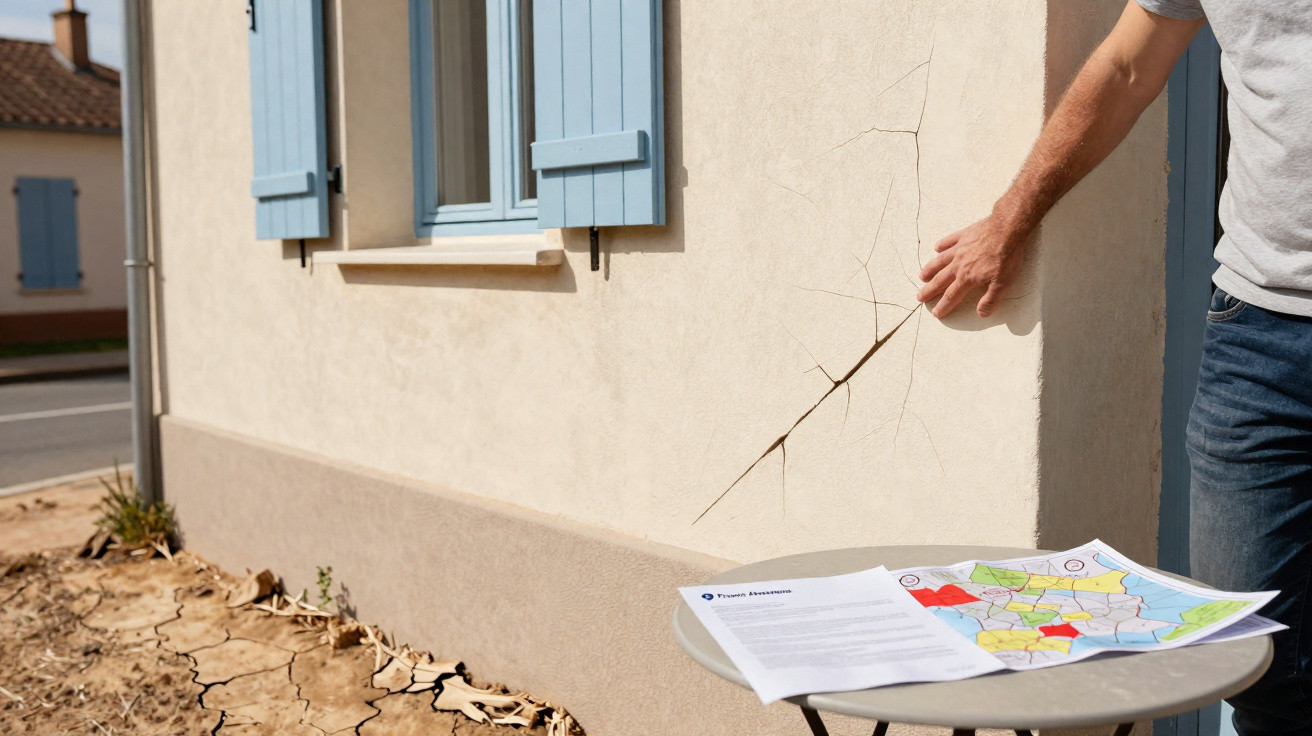
A deeply worrying issue for the people affected.
This is not something to brush off: cracks appearing on building façades could quickly become a serious headache for homeowners and property professionals alike. For residents, these visible splits can feel like a ticking time bomb, bringing the fear that the property will deteriorate further - or, in the worst case, end up collapsing entirely. Here is what you need to know about this phenomenon.
38 French municipalities are heavily affected
Subscribe to Presse-citron
Last year, the website L’Internaute analysed data on municipalities where at least 90% of the area is exposed to a high risk of cracking. Those findings back up a projection published in 2021 by France Assureurs, a federation bringing together 247 companies in the sector.
What “retrait-gonflement argile” (RGA) actually means
The cracking seen on many buildings is more specifically referred to as “retrait-gonflement argile” (RGA) - shrink–swell of clay soils. It occurs when clay-rich ground absorbs water, particularly during the wet autumn and winter months, and then contracts during dry spells, especially in summer. These changes in volume cause the ground to shift, weakening house foundations and leading to cracks that can sometimes be substantial.
Where the risk is concentrated
At present, thirty-eight municipalities are especially affected by the RGA phenomenon. More than half of them are located in Haute-Garonne and the neighbouring departments, while others are on the Côte d’Azur. Other areas are also exposed, but to a lesser extent. Overall, more than 515,000 residents are exposed to this risk.
Here is the list of the 38 municipalities particularly affected by this RGA:
- Aniche: 91.72% of the municipal area exposed to RGA level 3 (the highest stage)
- Apt: 93.52%
- Auch: 99.99%
- Balma: 99.99%
- Bon-Encontre: 90.08%
- Castanet-Tolosan: 94.39%
- Castelginest: 100.00%
- Caussade: 99.26%
- Condom: 99.51%
- Coubron: 92.44%
- Escalquens: 95.94%
- Esvres: 95.90%
- Fontenay-sous-Bois: 91.33%
- Foulayronnes: 98.01%
- Gardanne: 94.83%
- Gignac-la-Nerthe: 99.50%
- La Verrière: 99.87%
- Le Pré-Saint-Gervais: 92.60%
- Les Ulis: 99.74%
- L’Isle-Jourdain: 99.75%
- Montfermeil: 98.98%
- Nandy: 97.62%
- Noisy-le-Sec: 90.82%
- Ormesson-sur-Marne: 99.99%
- Port-de-Bouc: 90.01%
- Pulnoy: 96.66%
- Quint-Fonsegrives: 98.26%
- Ramonville-Saint-Agne: 99.37%
- Revel: 93.11%
- Rognac: 97.17%
- Rousset: 99.10%
- Saint-André-de-Cubzac: 90.85%
- Saint-Jean: 99.99%
- Saint-Orens-de-Gameville: 98.18%
- Sceaux: 94.07%
- Seichamps: 94.88%
- Vaujours: 90.52%
- Velaux: 97.09%
France Assureurs’ warning on drought-related subsidence
In its 2021 report, France Assureurs also highlighted the drought-related threat behind this type of damage: “The drought peril concerns the phenomenon of subsidence, meaning the impact of damage to buildings (almost exclusively single-family houses) caused by shrinkage, then swelling, of subsoils, initially linked to insufficient rainfall coupled with high temperatures.” Further information is available on this organisation’s dedicated page.






Comments
No comments yet. Be the first to comment!
Leave a Comment