
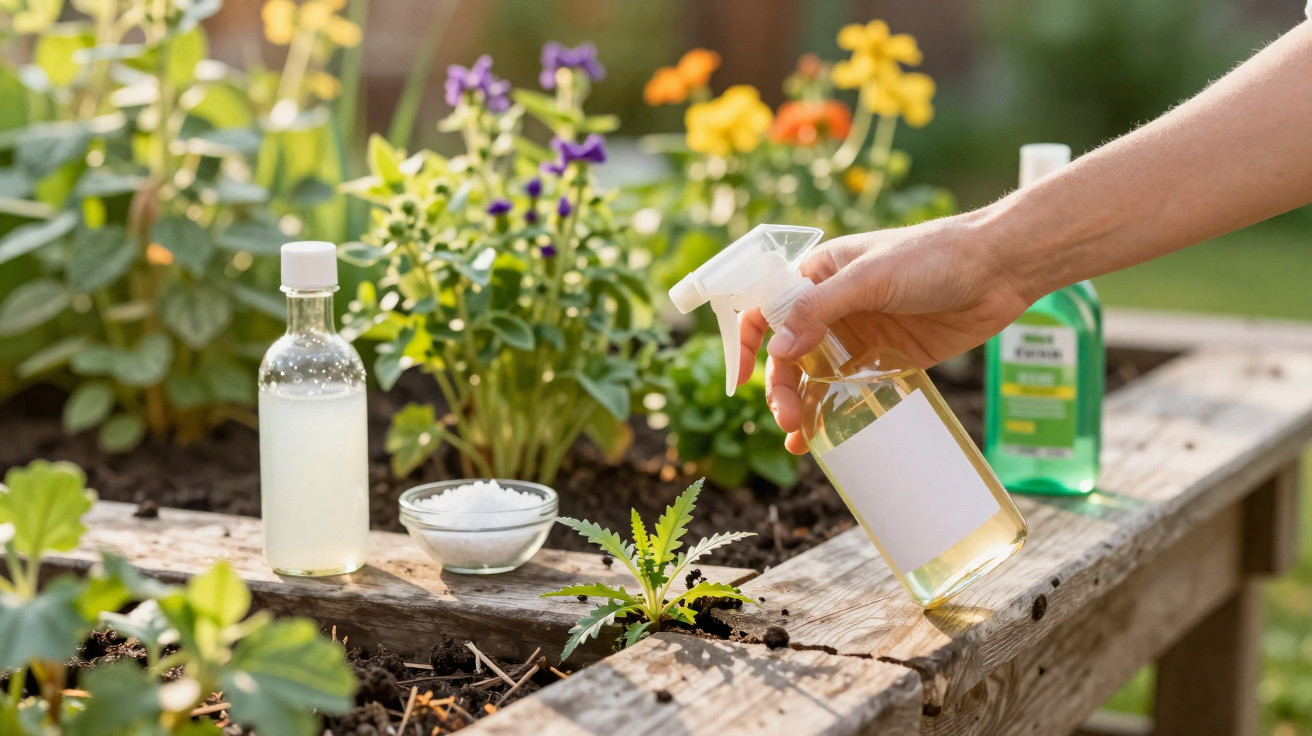
At daybreak, the sun is only just showing itself and the garden already seems worn out: patio flags split with age, a scattering of stubborn daisies in the lawn… and, threading through it all, those thin, determined weeds that always appear to come out on top. You know the sort: they wedge themselves between paving, track the fence line, and edge around your roses like house guests who never took the hint.
With a mug of coffee in one hand and a spray bottle in the other, you pause. Do you reach for something harsh and chemical-smelling, or accept another session on your knees with a hand fork and a protesting back? Then you glance towards the kitchen: a bottle of white vinegar, a bag of salt, and a little dish soap by the sink.
It’s surprising what those three can do when you combine them.
Why weeds can’t stand white vinegar, salt and dish soap
The first time you spray weeds with white vinegar, it almost feels like getting away with something. It’s the same stuff you splash on salads and use to wipe glass, yet on a warm day the change is obvious within hours: dandelions look as if they’ve been scorched. Leaves twist, the colour drains to a weary yellow, and the cocky little rosettes you’ve been glaring at for weeks suddenly seem… less invincible.
Vinegar alone can stress them, but add salt and a little dish soap and the result shifts dramatically. Instead of merely looking miserable, the weeds begin to die back towards their centre.
Imagine a narrow gravel walkway to a shed, with every gap between stones stuffed with tiny weeds. A neighbour, fed up of stooping every weekend, tips white vinegar into an inexpensive garden sprayer, mixes in a handful of kitchen salt, then adds a small squirt of dishwashing liquid. They spray in late morning, once the sun is already warming the ground.
By late afternoon, the path looks drought-hit. Chickweed collapses, knotgrass flattens out, and even the stubborn thistle by the step starts to sag. Two days on, most of the gravel is bare again-and the neighbour hasn’t lifted a hoe. One homemade mix. Hardly any effort. A result you can actually see.
There’s straightforward reasoning behind this little “miracle”. White vinegar is acidic, and that acidity sears the tender tissues in leaves and young stems. Salt pulls moisture out of the plant by drawing water from its cells, forcing a kind of botanical dehydration. Dish soap doesn’t kill weeds on its own, but it does the quiet work in the background: it reduces surface tension so the spray spreads, sticks and soaks in, rather than beading and sliding off like rain.
Used together, they overwhelm the weed. Vinegar acts quickly, salt bites deeper and lasts longer, and the soap helps both cling to the foliage and get to work. That’s how a few pantry staples turn into a discreet little arsenal.
The exact recipe gardeners swear by (and where not to use it)
Here’s the simple approach many home gardeners rely on. Measure out about 1 litre of white vinegar (household strength-around 5–8% acidity is enough for most jobs). Tip in 2–3 tablespoons of ordinary table salt or fine sea salt. Stir or shake until it’s fully dissolved. Then add a teaspoon of dish soap and blend it in gently, so you don’t end up with a bottle full of froth.
Decant the mixture into a spray bottle or a small garden sprayer. Pick a hot, dry day-late morning is ideal-so the sun still has plenty of time to do its part. Spray straight onto the weed leaves, wetting them lightly but evenly. Then leave it alone and let the sunshine do the rest.
Now for the honest warning. This mix is effective, but it isn’t selective. It can’t tell the difference between a weed in a crack and the lavender you adore beside it. If the spray hits delicate plants, it can scorch them too, and repeated heavy use of salt in the same place can gradually spoil soil structure.
So be precise. It suits driveways, gravel, paving, and those awkward edges where nothing precious is growing. Near vegetable plots or flower beds, keep the nozzle low, spray only what you mean to hit, and choose a still day with no wind. Realistically, nobody lands on only weeds every time-accept that, and handle the mix with a bit of respect.
Sometimes the most satisfying solutions are the ones that smell like your kitchen, not like a factory. One long‑time gardener told me, “I swapped my usual weed killer for vinegar and soap. The first thing I noticed wasn’t the dead weeds, it was that my yard smelled like pickles instead of petrol.”
- Use it for “hard” surfaces
Paths, patios, gravel driveways, brick joints, and areas you don’t plan to plant in. - Wait for dry, sunny weather
Moisture or rain right after spraying can dilute the mix and weaken the impact. - Protect nearby plants
Cover delicate flowers, shrubs or vegetables nearby with a board or bucket while you spray. - Apply on young, tender weeds
Older, woody or deep‑rooted weeds may need several treatments or manual removal. - Don’t overdo the salt
Too much in the same spot, season after season, can leave the soil tired and almost lifeless.
A small bottle, a small gesture… and a different way of looking at your garden
Once you’ve used this trio of white vinegar, salt and dish soap, you start to move through your garden differently. Weed control stops feeling like a choice between chemicals and backache, and becomes a set of small, smart actions: a quick spray along the path today, a little hand-weeding around the roses tomorrow, perhaps some mulch next weekend. The war on weeds turns into a quiet conversation with your space.
You may also find your tolerance changes. Certain weeds-especially in the lawn or at the edge of a wilder patch-can start to feel less like opponents and more like proof the soil is alive. The mixture becomes one tool among many, rather than a weapon.
| Key point | Detail | Value for the reader |
|---|---|---|
| Three‑ingredient weed killer | White vinegar, kitchen salt and a little dish soap | Uses cheap, accessible products already in most homes |
| Best conditions | Spray on a dry, sunny day directly on weed leaves | Maximizes effectiveness with fewer repeat treatments |
| Where to use it | Gravel, paving, paths and non‑planted areas, with targeted use near beds | Reduces chemical use while protecting valuable plants and soil health |
FAQ:
- Question 1 Can I use this vinegar, salt and soap mix directly on my lawn?
- Answer 1
- It’s risky. The mix doesn’t distinguish between weeds and grass, so you’re likely to burn patches of lawn. For lawns, spot‑treat only single weeds with a small spray or use manual tools.
- Question 2 Will the weeds disappear forever after one treatment?
- Answer 2
- Not usually. Shallow, young weeds may die completely, but deep‑rooted ones can regrow. Expect to repeat the treatment or combine it with digging out tough roots.
- Question 3 Does the type of vinegar matter for this recipe?
- Answer 3
- Standard white spirit vinegar (around 5–8% acidity) works well for most home uses. Stronger horticultural vinegars exist, but they can be harsh on skin, soil and nearby plants.
- Question 4 Is this mixture safe for pets and children?
- Answer 4
- It’s less toxic than many synthetic weed killers, but it still burns plant tissue. Keep pets and children away while the area is wet, and store the mix out of reach in a clearly labeled container.
- Question 5 Can I store the leftover mixture for later?
- Answer 5
- Yes, you can keep it in a tightly closed, clearly labeled bottle for several weeks. Shake gently before each use, as the ingredients may separate over time.



Comments
No comments yet. Be the first to comment!
Leave a Comment