
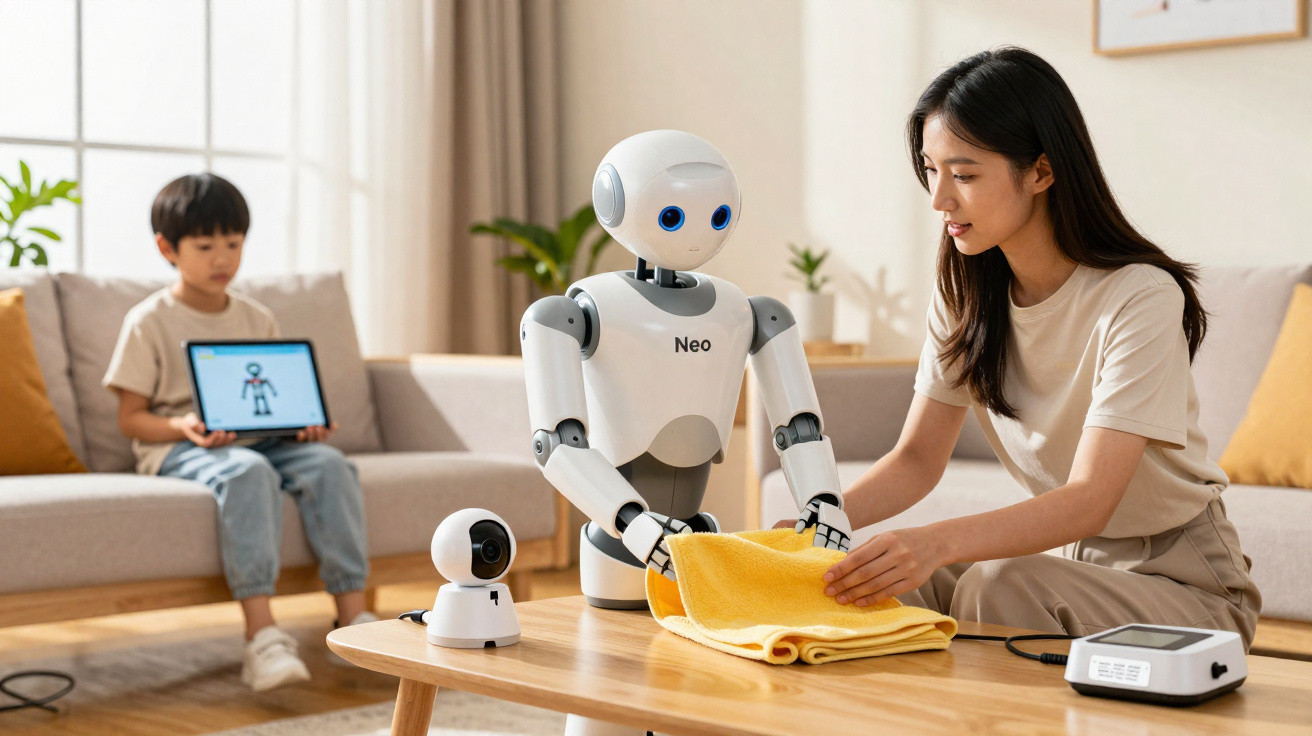
A humanoid robot built to operate inside private homes has now reached the consumer market, offering the ability to wash dishes, fold laundry, and help with cooking.
Its arrival marks a moment where domestic labour starts to move away from human hands and towards machines that can navigate, perceive, and react inside ordinary living spaces.
Early trials of home robot
During the launch of Neo, a full-sized humanoid robot intended for household chores, early adopters got an initial view of what a domestic robot can actually do with day-to-day work.
In close collaboration with those early deployments, engineers at the artificial intelligence firm 1X showed the robot retrieving objects, folding clothes, and completing other basic tasks around the home.
Initial trials pictured the machine progressing carefully through kitchens and living rooms, carrying out straightforward chores while a person supervised.
These early outcomes highlight both the potential of robotic help at home and the practical constraints that still define how such systems function today.
Seeing, steering, recording
Footage from cameras positioned at head height enables a robot to identify objects, but it also creates the possibility that somebody else could be watching.
Engineers refer to this as teleoperation: piloting a robot remotely and in real time, typically introduced first as a safety back-up.
Using a virtual reality headset, a remote assistant can view the scene through the robot’s perspective and guide its hands through awkward steps in the kitchen.
Once a company provides that assistant, policies around who gets access, when they can connect, what the cameras may show, and whether anything is recorded become just as crucial as the robot’s physical dexterity.
Simple chores remain difficult
Homes present robots with constant surprises, from crumpled shirts to slippery plates, and neither sits firmly in a mechanical grip.
At every moment, the machine has to stay balanced, estimate distances, and modulate motor force before a stumble becomes broken crockery.
Minor errors accumulate quickly, because a twisting door handle or a damp towel sagging in the wrong place can disrupt the entire movement.
That is why early humanoids for the home are cautious and slow, and why remote guidance still appears in demonstrations.
Humans teaching robots
To become quicker, robots often need to mirror people, so firms gather many hours of video showing humans folding laundry or loading dishwashers.
Researchers commonly apply imitation learning-training a robot from human examples-to convert those recordings into repeatable motions.
When a remote operator intervenes, the robot can save the successful sequence and attempt it again later without the helper.
With enough practice, the range of skills can grow, but progress remains linked to human labour and to vast volumes of footage from inside homes.
Privacy rules for home robots
Purchasers signed an agreement that can restrict remote access to specific hours and exclude certain rooms.
“If we don’t have your data, we can’t improve the product,” said Bernt Børnich, CEO of 1X Technologies.
Measures such as face blurring and no-go zones can lower risk, but they also underline how much the system is expected to observe.
Even with restrictions in place, a home robot turns privacy into a configurable setting that households must actively manage, rather than something assumed by default.
Safety limits in practice
Safety engineers aim to keep a helper machine non-threatening, because a robot with arms has the ability to knock over a child.
Companies impose limits on how much it can lift, and sensors can halt movement when the hands encounter unexpected resistance.
Remote supervision can spot problems early, but it also introduces a fresh target for hackers.
Until standards become more robust, early customers may end up with a cautious robot that declines risky jobs and pauses until it is given permission.
Autonomy races ahead
In other efforts, Tesla has promoted Optimus as a general-purpose humanoid intended to take on tedious or hazardous work.
Figure AI developed Helix to link vision, language, and action, with the goal of achieving more independent control.
Both strategies still rely on data from real homes, because a robot learns most effectively when it can fail safely.
Driving towards autonomy might reduce privacy exposure, but it can also shift mistakes away from human oversight and onto software alone.
Cost of owning a robot
Early buyers were offered a $499-per-month subscription or $20,000 ownership, with US deliveries beginning in 2026.
That price covers the hardware, ongoing software updates, and human support that can step in when the robot becomes stuck.
A subscription can also distribute risk, as a company can replace failed units and gather repair information across many households.
So long as remote help remains part of the service, the true cost involves not only money but also shared access.
Questions before buying
Before bringing a robot into the home, families can insist on clear information about who may watch, record, or control it.
Account controls should display access windows, room restrictions, and obvious signals showing when a remote operator is connected.
Written policies are important, but real-world behaviour matters more, because a helper robot will encounter edge cases nobody anticipated.
Until households draw their own boundaries, convenience will continue to pull private spaces into a system designed around learning.
Promise and limits of robots
Humanoid helpers now suggest less laundry and more free time, yet their performance still depends heavily on people and data.
Firm rules on access, safety, and privacy may determine whether these machines feel like practical tools or unwanted intruders.


Comments
No comments yet. Be the first to comment!
Leave a Comment