
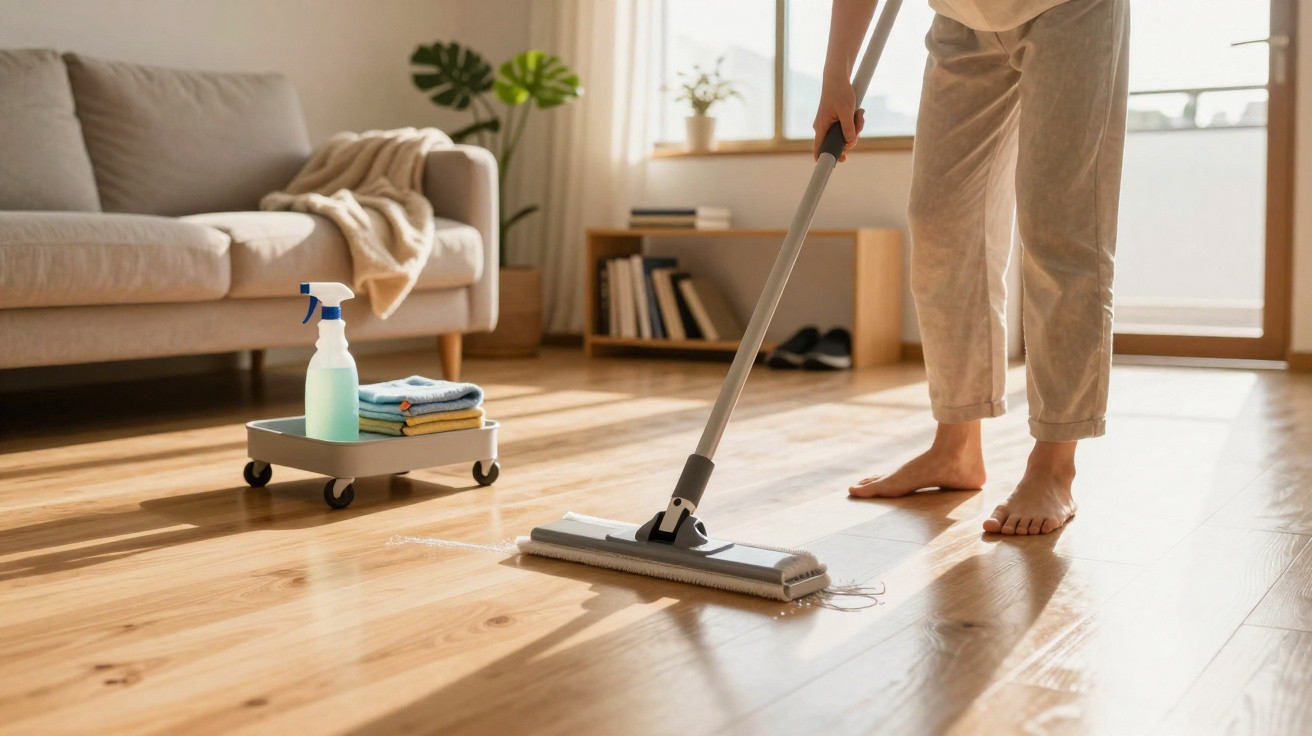
It often begins with a faint crunch beneath a bare foot. A stray breadcrumb, a dried fragment of leaf, some anonymous speck that certainly didn’t drop from the ceiling. You glance down and, all at once, the entire floor comes into view: dust gathered along the skirting boards, pet hair collecting in the corners like miniature tumbleweeds, and that subtle sticky patch by the fridge you’ve been sidestepping for three days.
Your eyes move to the worktop piled high, the shoes left in odd places, the laundry basket in the hall sitting there like a quiet reproach. Strangely, your shoulders tighten before you’ve even reached for a brush.
You aren’t only noticing the floor. You’re seeing the one household job that quietly influences how everything else feels.
The invisible backbone of a calm home
Step into any house and you sense it almost immediately. Not the paint on the walls, not the stylish décor. The floor.
When it’s clear, swept and generally looked after, the whole home feels “in hand”, even if there’s a mound of folded laundry on the sofa. When it’s dusty, littered with crumbs, or scattered with stray socks and toys, your brain flags disorder before you can even explain why.
That’s the understated influence of floor care. It rarely demands attention, yet it shapes the emotional weight of every other chore.
Think back to the last time you went into the kitchen to make something. Perhaps the worktops were cluttered, but you found a small patch to wipe down and carried on. Even so, that gritty feeling underfoot got on your nerves, didn’t it?
A 2023 survey by a European cleaning brand reported that people ranked “vacuuming and sweeping” among their least favourite chores. At the same time, 68% said “clean floors” made their whole home feel more organised, even if other rooms were untidy. That pairing isn’t accidental.
One mum I spoke to laughed that she could tolerate unfolded laundry for a week. “But if my feet stick to the floor,” she said, “my whole mood goes down the drain.”
There’s a straightforward reason for this. The floor is the biggest visible surface in your home. Even when you’re not consciously thinking about it, your eyes and your body are constantly interacting with it.
When the floor is grimy, everything else feels more effortful. Cooking turns into a careful dance around crumbs. Getting down to play with children on the floor feels far less inviting. Working from home becomes more draining when every trip to the kitchen highlights how long it’s been since you swept.
Clean floors work like a neutral backdrop to everyday life. They won’t fix clutter, bills or work pressure. But they do remove a steady, low-level irritation that can seep into everything.
How to turn floor care into your anchor habit
Here’s the surprising shift: stop treating floor care as something you do “if you have time”, and make it your anchor task. In other words, invert the usual approach.
Choose one or two areas that genuinely carry your day-most often the kitchen and the entryway. These spots collect crumbs, mud, pet hair and everyday debris faster than anywhere else. They’re also the first places your mind registers when you walk through the door.
Next, attach a tiny floor routine to something you already do. Sweep for three minutes right after you load the dishwasher. Run the vacuum once you’ve made your morning coffee.
This isn’t about a full deep clean. It’s simply a daily reset that signals: you’ve reclaimed this space.
The classic trap is waiting until the whole house feels out of control, then burning an entire Saturday trying to “catch up”. By then, you’re already worn out, resentful, and a bit embarrassed. We all know that moment of looking around and thinking: how on earth did it get this bad?
A kinder, more workable pace tends to win. Small, almost half-hearted gestures that stop the floor crossing that invisible threshold from “lived-in” to “sticky disaster”. One quick sweep under the dining table after dinner. A fast pass at the front door when you notice dried mud-rather than pretending it isn’t there.
Let’s be honest: nobody keeps this up every single day. You’ll miss days. Some weeks, life will take over. What matters is that floor care becomes your default response, not a last-minute rescue mission.
The goal isn’t perfection, it’s relief.
“Once I stopped chasing a spotless house and focused only on the floors in the kitchen and hallway, everything else felt lighter,” says Léa, 34, who works full-time and has two kids. “I still have clutter, I still forget the laundry sometimes. But walking on a clean floor gives me this weird sense that I’m not failing at adulthood.”
- Start small: choose one high-traffic zone and give it priority.
- Go short: 5–7 minutes with a broom or vacuum is enough for a reset.
- Pair it: link floor care to an existing habit (coffee, dishes, bedtime routine).
- Lower the bar: aim for “no visible crumbs or sticky spots”, not magazine-level shine.
- Protect your energy: keep tools accessible, not buried in a cupboard behind ten things.
When the floor changes, everything else shifts
Once you clock the connection between your floor and your mental load, it’s difficult to ignore. Those first morning steps-barefoot on something clean rather than dusty-slightly change the tone of your day.
You may notice you’re more inclined to cook because the ground no longer feels like a battleground. Children start playing on the rug again instead of migrating to the bed or sofa. You feel less self-conscious opening the door when someone turns up unexpectedly.
This single habit won’t transform you into a new person. It simply quietens a layer of background noise. And when that noise drops, you often find a little more patience left for everything else: the laundry, the emails, the endless life admin.
| Key point | Detail | Value for the reader |
|---|---|---|
| The floor is the “silent signal” of the home | It’s the largest visible surface and constantly in contact with your body and eyes | Helps explain why you feel stressed even when only the floor is messy |
| Small, frequent resets beat big cleanups | 5–10 minute sweeps in key zones keep chaos under control | Makes cleaning feel doable, even on busy days |
| Anchor habits create momentum | Linking floor care to daily routines stabilises your environment | Gives a practical way to feel more in control without perfectionism |
FAQ:
- Question 1 Is floor cleaning really more impactful than tidying surfaces?
- Question 2 How often should I realistically clean my floors?
- Question 3 What if I have pets and kids and the floor never stays clean?
- Question 4 Which tools make floor care easier to keep up with?
- Question 5 How do I stop feeling guilty when I can’t keep everything spotless?


Comments
No comments yet. Be the first to comment!
Leave a Comment