
There’s a particular kind of disappointment when a supposedly “clean” load comes out of the machine carrying a wet-dog whiff. Sorting it out doesn’t require a cupboard full of niche cleaners or hours of scrubbing. It begins with two everyday staples you probably already have, plus a couple of habits that are easy to keep up.
It happened on a Tuesday morning. The bathroom window was slightly open under a porridge-coloured sky, and as I lifted a T-shirt from the drum I caught it: that faint, stale mustiness sitting underneath the scent of detergent. The door seal looked fine-until I pushed a thumb into the fold and felt a slippery bead track along the ridge. The fix is far more straightforward than it seems.
Why your washing machine smells in the first place
A smelly washing machine usually isn’t “filthy” in the obvious, bin-like way. The real culprit is a gradual layering of soap scum, fabric conditioner residue, lint, and hard-water minerals that merge into a clingy coating. That film becomes a buffet for microbes, and microbes create odours-especially when the door stays closed and the drum remains just a touch damp.
A neighbour in Bristol told me her drum began to pong after a winter of quick 30°C cycles and generous fabric conditioner. She assumed a stronger fragrance would mask it; instead it made things worse, blending floral notes with something distinctly pond-like. That’s how these smells usually arrive: slowly, by accumulation, rather than from one single bad wash.
Here’s the science without the faff. White vinegar breaks down limescale and soap residue, loosening the stubborn film so it releases. Bicarbonate of soda tackles odours and helps bring the pH back towards neutral, which supports rinsing away whatever the vinegar has softened. Add hot water through the system and the biofilm stops gripping. Bicarbonate of soda and white vinegar are the only two things you need.
The two-ingredient clean: a simple routine
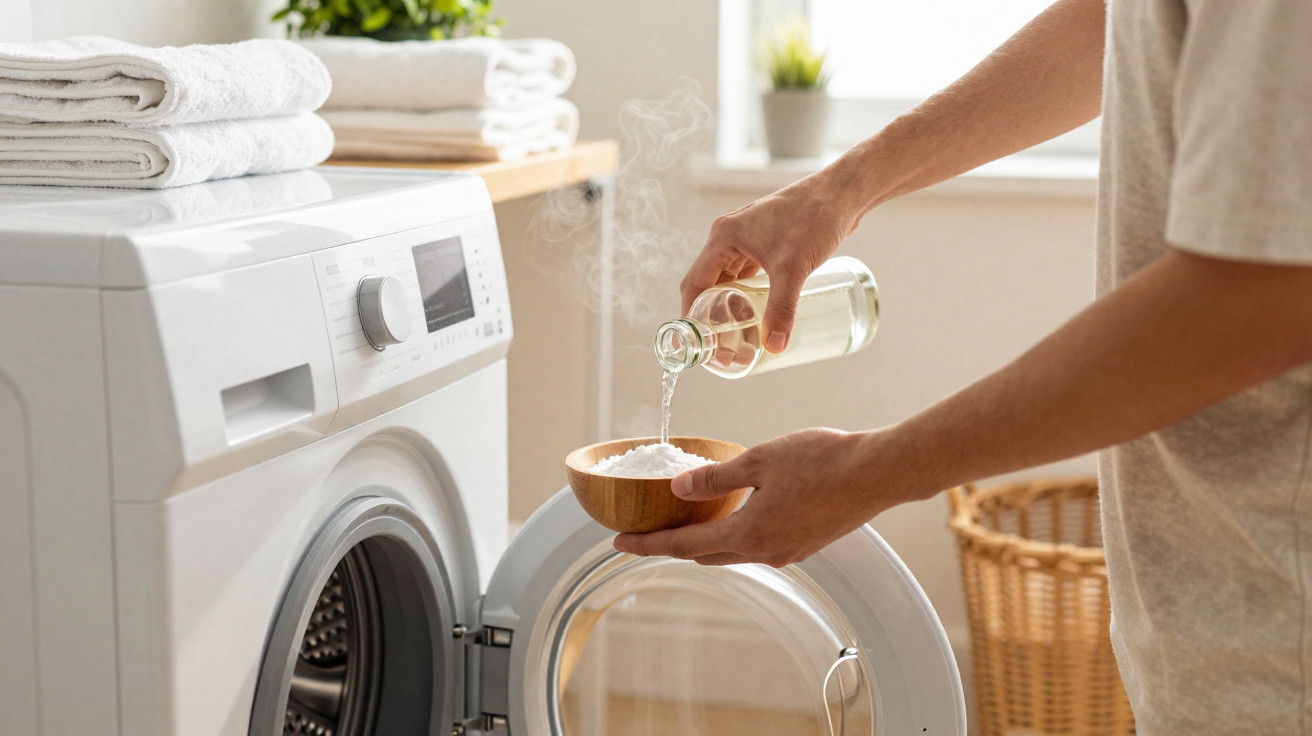
Begin with the machine empty. Tip 250–400 ml of plain white vinegar directly into the drum, then run the hottest maintenance cycle your machine offers-ideally 60–90°C. If your machine allows you to pause mid-cycle, stop it for 20–30 minutes so the vinegar can sit on the internal surfaces, then let the programme finish.
After that, scatter 2–3 tablespoons of bicarbonate of soda into the drum and run a short hot rinse. When it’s done, leave the door open and wipe the rubber seal, the inside of the door glass, and the inner drum using a clean cloth. Never mix vinegar with bleach - ever. If you’ve used bleach lately, wait a day and run a couple of rinse cycles before you try this method.
To stop the odour returning, a few small adjustments make a big difference: use less detergent, avoid fabric conditioner on towels, and let the machine air out so moisture doesn’t linger. Realistically, nobody remembers to do this every single day. Leave the door and detergent drawer ajar after every wash.
“If your machine smells, it’s not the clothes - it’s the biofilm. Break the film and the smell goes with it,” a repair engineer told me on a call-out in Leeds.
- Monthly: run one hot vinegar cycle, followed by one short bicarb rinse.
- After washing: wipe the inner lip of the door seal where water pools.
- Use powder for very dirty loads; gels can cling more.
- Once a season: remove the drain filter and clear out the fluff.
- Run at least one 60°C wash each week if you mostly use cold cycles.
What to expect - and how to keep it easy
Once you’ve done the first vinegar cycle, the smell often drops from “swampy” to “almost gone”. The bicarbonate rinse typically completes the reset, leaving the drum neutral rather than artificially perfumed. If the machine has years of residue, repeat the two-step routine the following week and inspect the filter for trapped coins, hair ties, or compacted lint that can hold on to sour water.
A small shift in perspective helps. You’re not launching a deep-clean campaign against a broken appliance; you’re simply helping a water-based machine dry out properly between “baths”. Leave the door slightly open, pull the drawer out about a centimetre, and give the seal a two-second wipe as you take out the final sock. These are tiny habits, not weekend chores.
In hard-water homes, vinegar is a quiet workhorse because it softens scale each time it circulates. In busy households, the routine matters even more-more loads mean more residue. Kept to a monthly rhythm, the whole thing takes less time than making a cup of tea and waiting for the kettle to cool.
The science made friendly: vinegar and bicarb, no drama
Treat vinegar as the dissolver and bicarbonate as the deodoriser. Vinegar is mildly acidic, so it helps melt the chalky deposits that detergent likes to stick to. Bicarb is mildly alkaline, so it absorbs lingering smells and supports rinsing away loosened grime. If you add them at the same time, you mostly get a fizzy reaction that ends up as a fairly neutral salty liquid-satisfying, but not especially useful for cleaning the machine’s hidden areas. Use them one after the other and you get the benefits of both.
More than a clean drum: tiny rituals that change the whole room
Clean laundry is more than a pleasant smell. It’s confidence that your gym kit won’t come out with a swampy edge, that the baby’s sleepsuits won’t pick up a stale note overnight, and that visitors won’t notice a faint hum in the hallway on rainy days. Share the routine, pass it on to housemates, or teach it to the teenager who’s just discovered fabric conditioner. The two-ingredient approach sticks because it’s cheap, quick, and forgiving-and it works on a Tuesday when the sky looks like porridge. Give it a go once this week and see how the machine smells three days later. Then tell someone your favourite small household hack.
| Key point | Detail | Why it matters to you |
|---|---|---|
| Two ingredients | White vinegar (250–400 ml) and bicarbonate of soda (2–3 tbsp) | Low cost, already in your cupboard |
| Order matters | Run a hot vinegar cycle, then a short bicarb rinse | Prevents neutralising fizz and cleans more deeply |
| Keep it fresh | Door and drawer ajar, quick wipe of the seal, repeat monthly | Stops the smell returning with minimal effort |
FAQ:
- Which two household ingredients are we talking about? Plain white vinegar and bicarbonate of soda. No scented vinegars, no baking powder-just the basic versions.
- Will vinegar damage the rubber seal or hoses? Used occasionally and diluted by a full hot cycle, white vinegar is gentle on modern seals. Don’t leave rubber parts soaking in neat vinegar for hours.
- Can I pour vinegar and bicarb in together to save time? You’ll get a pleasing fizz, followed by a mostly neutral solution that cleans less effectively. Split it into two steps for better results.
- How often should I do this routine? Monthly works for most homes; fortnightly if you wash constantly or live in a hard-water area. Wiping the seal after each wash helps it last longer.
- What if the smell comes back quickly? Check the drain filter for trapped fluff, coins, or hair ties. Run one 60°C load per week, cut down on conditioner, and let the machine dry with the door and drawer open.

Comments
No comments yet. Be the first to comment!
Leave a Comment