
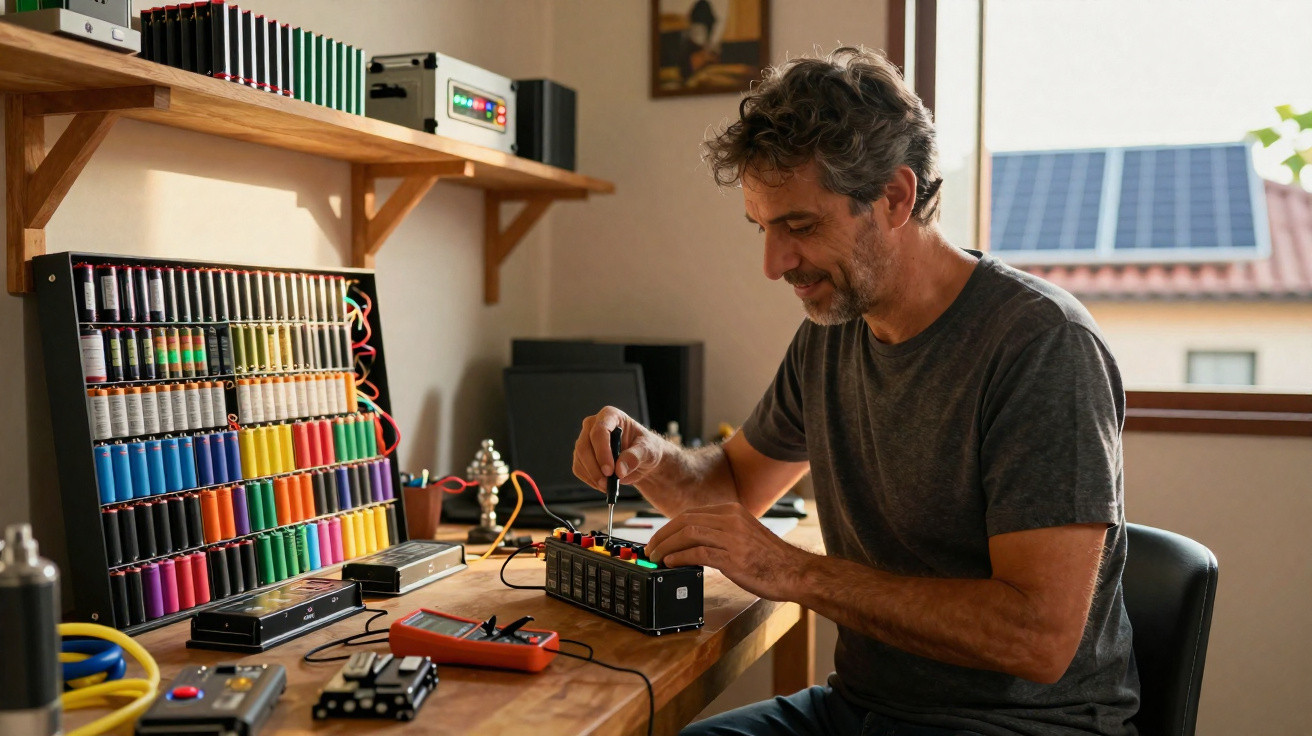
On a small property well away from town, one resident decided to challenge the logic of the electricity bill by putting scrap technology to work.
What began as a curiosity turned into a personal energy-independence project: a home-built setup that relies on hundreds of discarded laptop batteries to keep a house running almost off the traditional mains grid.
From e-waste to a domestic power source
Since 2016, this alternative-energy enthusiast has been supplying his home using an unlikely combination: more than 650 used laptop batteries, paired with solar panels and a control system he designed himself. The aim is straightforward but bold: cut reliance on the utility provider as much as possible.
"A collection of batteries that would have gone in the bin now keeps lighting, equipment and some household appliances running every day."
The system’s core sits in a small shed about 50 metres from the house. Inside are refurbished batteries arranged into blocks, wired into charge controllers and an inverter that turns stored energy into usable electricity for standard household sockets.
How the project began in 2016
Before he started working with laptop batteries, the resident already had a basic solar setup: a few panels, an old forklift battery, a controller and an inverter. It helped take the edge off the electricity bill, but it did not provide true independence.
The turning point came when he noticed that businesses, repair shops and individual users were discarding laptop batteries that still contained reusable cells. From there, he began to “collect” them, testing each cell one by one.
"He started with around 650 used batteries to build blocks of roughly 100 Ah each, creating a large modular energy ‘bank’."
For the main connections, he chose thick copper cabling to reduce energy loss and heat build-up. Over time, the installation expanded to more than a thousand batteries in total, counting both those in service and those kept as spares or replacements.
A shed that became an improvised power station
The shed effectively operates as a micro power hub. Three key elements are concentrated there:
- roof-mounted solar panels responsible for generation;
- battery blocks arranged on shelving;
- electronic equipment for control, safety and energy conversion.
During the day, the panels charge the batteries. At night, or on overcast days, the house draws power from stored energy. According to the resident, the system has been running for almost a decade without notable incidents-such as fires or swollen batteries-thanks to careful sizing and continuous monitoring.
The role of repurposed laptop batteries
Laptop batteries are typically built from lithium-ion cells configured in series and parallel. When a battery is “dead” for use in a computer, a portion of its cells often still has useful life left.
His process includes:
- opening discarded packs and separating the cells;
- testing each cell for capacity, voltage and internal resistance;
- disposing of faulty cells correctly;
- grouping only similarly performing cells into new modules.
Those modules are then interconnected to form large energy banks, capable of storing a significant share of the solar panels’ daily output and providing hours of autonomy.
What this experience shows about energy independence
This case illustrates how technical know-how, patience and access to electronic scrap can produce practical outcomes. It is not a simple “trick”, but a system built as a long-term hobby that ultimately became a working energy solution.
"The initiative highlights a rarely discussed potential: extending the working life of lithium components that, in many cases, may still have years of usable service left."
For anyone considering something similar, several points stand out:
| Aspect | Advantage | Challenge |
|---|---|---|
| Battery cost | Raw material is effectively free, sourced from discard streams | Requires time to find, test and select |
| Environmental impact | Cuts e-waste and reduces demand for new batteries | Requires proper disposal of bad cells |
| Safety | A well-sized design lowers risk | Assembly mistakes can cause overheating and short circuits |
| Technical complexity | Enables extensive system customisation | Demands knowledge of electrical and electronic principles |
Risks, limits and necessary precautions
Working with lithium-ion is never straightforward. Short circuits, overcharging or physical damage can lead to overheating and, potentially, fire. A DIY project like this only makes sense for someone who understands current, voltage and protection, and who can use measurement equipment properly.
Key precautions include:
- fitting fuses or circuit breakers to each battery group;
- preventing overcharge by using good-quality controllers;
- monitoring module temperature, especially in hot weather;
- keeping the system away from living areas and ensuring adequate ventilation.
Even with the resident’s positive results, industry professionals often advise that, for most people, systems using new, certified batteries should be the default option-despite the higher upfront cost.
How this approach connects with the future of energy
While large companies invest in batteries that promise to last decades without recharging, examples like this point to a parallel path: making better use of what has already been manufactured. Rather than waiting for perfect technologies, it can be possible to extract more usage cycles from equipment that has already been thrown away.
In rural settings, remote communities or areas with an unstable grid, hybrid systems that include repurposing can serve as a bridge-reducing reliance on diesel generators and improving predictability of supply. In urban areas, the idea can inspire smaller solutions, such as emergency battery banks or educational projects.
What terms like Ah, inverter and charge controller mean
A few concepts make the project easier to understand:
- Ah (ampere-hour): indicates how much charge a battery can store. A 100 Ah module, for instance, can theoretically supply 10 A for 10 hours.
- Charge controller: the device that manages energy flowing from solar panels into batteries, preventing overcharge and extending service life.
- Inverter: converts the batteries’ direct current (DC) into alternating current (AC), which is what most homes use.
By combining these elements, the resident has turned a simple shed into a kind of hands-on distributed-energy laboratory, fuelled by technology many would consider obsolete.
For readers considering what this could mean in practice, the most realistic takeaway is not copying the setup exactly, but recognising discarded batteries as a resource that can still be responsibly developed in experimental, community or educational projects focused on the energy transition.



Comments
No comments yet. Be the first to comment!
Leave a Comment