
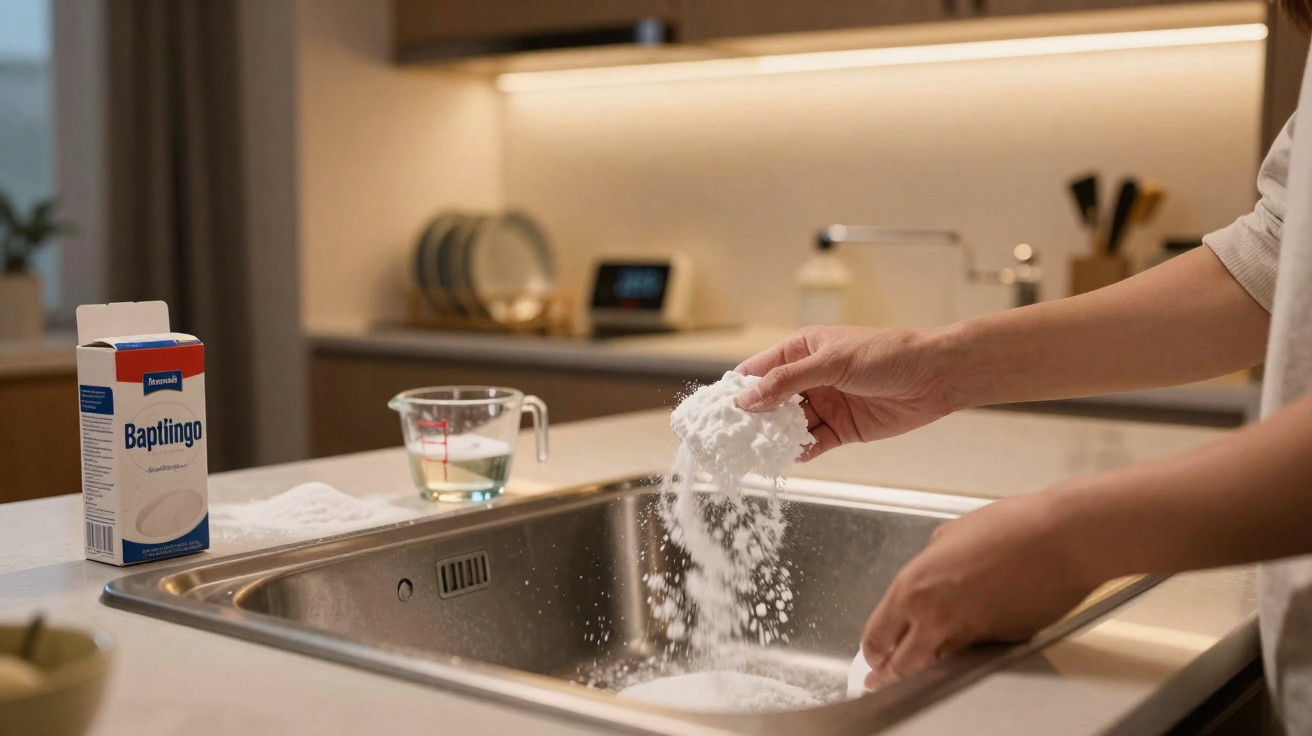
Putting baking soda down the kitchen drain before going to bed is a household tip mainly used to minimise odours and assist with the upkeep of surface residue. The hours when no water is flowing allow the powder to stay in contact with the trap for longer, although it will not, by itself, dissolve large amounts of hardened grease. This approach is most effective as preventive maintenance for a sink that is still draining properly.
What is the purpose of putting baking soda down the drain overnight?
Baking soda is mildly alkaline and can neutralise some of the acidic compounds linked with unpleasant smells. In a kitchen sink, small food particles, grease and organic matter may remain in the trap even after the water has drained away.
Applying it before a period when the sink will not be used stops it from being immediately washed away during further washing-up. As a result, it has longer contact with residue around the drain opening and trap.
- It may help lessen certain smells coming from the drain;
- It stays in the pipework for longer while the sink is unused;
- It supports the maintenance of surface residue;
- It is better suited to prevention than unblocking;
- It does not replace regular cleaning of the trap.
Why can doing this before bed be better than during the day?
Throughout the day, tap water, washing-up liquid and food debris repeatedly pass through the kitchen drain, quickly carrying away any added baking soda. At night, reduced use lets it remain in place for several hours. The benefit comes from this extended contact time, rather than from any special reaction that takes place overnight.
Can baking soda actually dissolve built-up grease?
With small amounts of recent residue, its alkalinity may make a modest contribution to cleaning, but household baking soda is comparatively mild. It should not be regarded as a degreaser that can independently dissolve a thick layer of solidified oil inside the pipework.
To reduce build-up, the most important step is preventing grease from reaching the pipe in the first place. Used frying oil should be set aside for suitable disposal, while solid leftovers should be scraped from plates before washing them.
- Do not pour used cooking oil into the sink;
- Use a strainer or sink basket to catch food remnants;
- Remove excess grease from pans before washing them;
- Clean the trap when accessible material has accumulated;
- Seek mechanical drain clearance if the water is already draining slowly.
Is it necessary to mix baking soda with vinegar?
No. The foam created by combining baking soda and vinegar may look powerful, but it results from a basic substance reacting with an acidic one, producing mainly water, carbon dioxide and salts. The fizz may dislodge small amounts of dirt near the surface, yet the mixture neutralises much of the chemical properties of both ingredients and is not a dependable solution for a pipe blocked by grease.
The trick is more useful for odours than an existing blockage
In a normally functioning sink, a small amount of baking soda in the drain can occasionally be used before an extended period without use, then rinsed away afterwards. There is no technical need to repeat the process every night, and using large quantities may simply leave powder collecting in the trap without providing extra benefit.
If water starts to drain slowly, comes back up through the drain or remains standing in the bowl, the issue has moved beyond preventive maintenance. In that case, cleaning the trap or mechanically clearing the blockage is far more effective. Baking soda works best before a blockage has developed: it primarily helps with odour control and light maintenance by making use of the hours when nobody is using the sink.




Comments
No comments yet. Be the first to comment!
Leave a Comment