
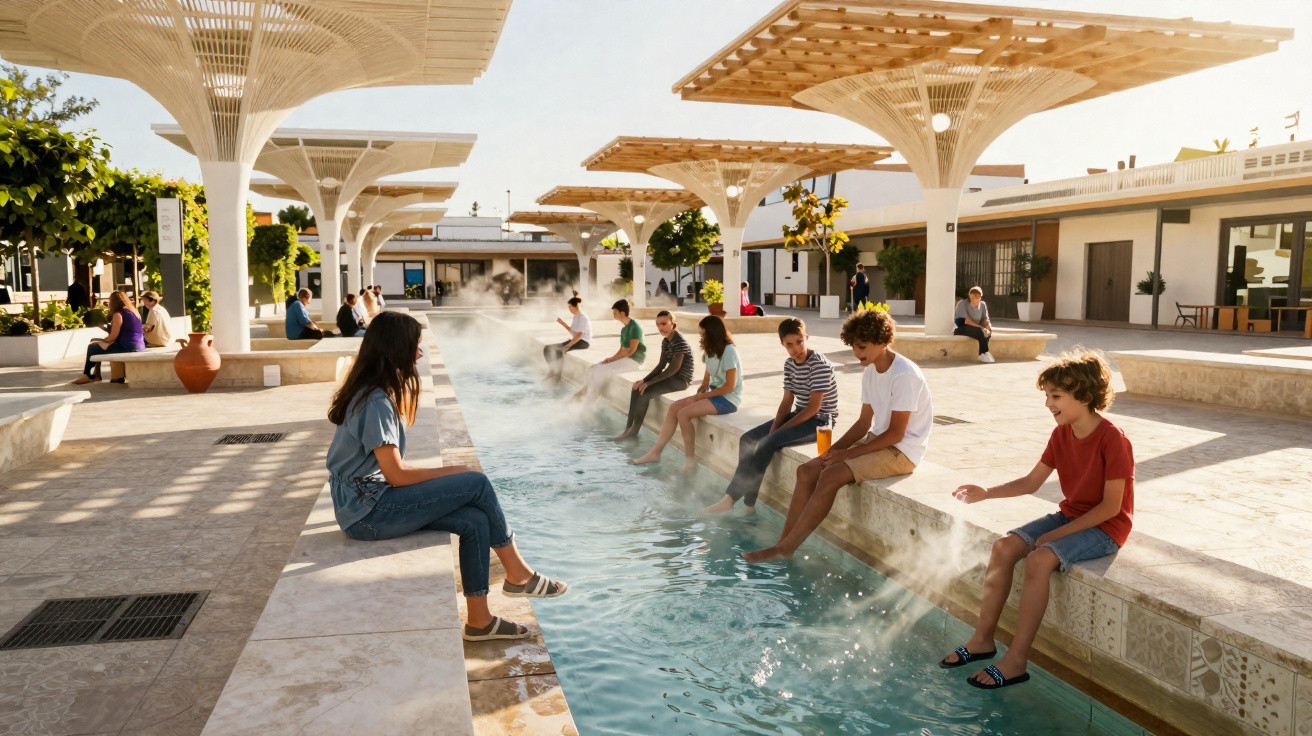
Seville is rethinking sustainable urban planning by taking on extreme heat without relying on conventional air conditioning. The city’s approach revives time-tested engineering to deliver thermal comfort in open public spaces, in a way that is both environmentally responsible and genuinely workable for the future of cities.
How does the Cartuja Qanat project in Seville work?
Installed on Thomas Alva Edison Avenue, the scheme reintroduces the historic concept of underground water channels, originally known as a qanat. This upgraded infrastructure uses specially designed pipework to move cool water in a controlled way, lowering surface temperatures through cooling that is both sustainable and efficient.
By combining water circulation with physical barriers and natural shade, the area can be cooled significantly without drawing large amounts of electricity. The result is an urban ecosystem that creates pleasant microclimates and shows how bioclimatic technology can reduce the harsh effects of global warming in today’s large metropolitan areas.
The system brings together several key components to cool the urban environment in a smarter way:
- Underground galleries: Channels that carry cold water beneath ground level.
- Ceramic elements: Materials that help disperse heat and preserve local coolness.
- Natural shading: Physical screens and vegetation that block direct solar radiation.
- Thermal comfort: A real reduction in the temperature pedestrians actually feel in public spaces.
- Open spaces: Places for people to gather that are protected from the most extreme urban climate effects.
What are the main aims of this urban initiative?
At its heart, the project is designed to bring public areas back to life-spaces that often become completely deserted during the hottest months of the year. By making these places usable again, it supports social interaction and helps local commerce operate in a safe and pleasant setting.
Alongside this, the initiative aims to set repeatable benchmarks for other parts of Europe that face similar climate emergencies each year. Proving that passive cooling can be economically viable encourages wider uptake of sustainable architecture in commercial projects and promotes more conscious urban development.
How does bioclimatic architecture transform spaces?
Using natural resources intelligently makes it possible to reshape cities without environmental harm or excessive electricity demand. This shift improves quality of life by creating efficient thermal refuges that safeguard public health from the increasingly common conditions of extreme heat.
Structural Innovation
Technological Integration
The project functions as a living laboratory, focused on testing ecological solutions at scale.
Traditional elements are given a new technical application to address real and urgent urban problems.
When architecture is planned around strict climate criteria, it changes how public squares can be used-especially those that suffer under constant solar radiation. These structural interventions show that sustainable passive-cooling solutions can provide practical alternatives that support environmental preservation and modern urban planning.
The site’s design includes practical improvements centred on community wellbeing:
- Installation of intelligent bioclimatic barriers.
- Use of high-dissipation ceramic materials.
- Optimisation of underground water flow.
Who are the partners involved in the technological development?
A strategic partnership between Seville City Council and the public water company Emasesa underpins the system’s operational feasibility. Together, they combine essential administrative capacity and technical expertise to implement these new passive cooling technologies successfully.
On the academic and scientific side, the University of Seville works with the Eduardo Torroja Institute of the CSIC to validate climate data. The Innovarcilla Foundation also contributes, bringing specialist knowledge in innovative materials to refine the project’s ceramic components.
This coordinated collaboration makes it possible to deliver strong results in the urban environment:
- Advanced scientific research applied to urban engineering.
- Development of highly efficient ceramic alloys.
- Continuous monitoring of regional thermal indicators.
Why revive ancient techniques to deal with extreme heat?
Looking to the past can guide contemporary engineering towards solutions that are both viable and environmentally sound in today’s global temperature crisis. In the same way that scientists propose an innovative brick to cool cities, Seville demonstrates that updated historical resources can deliver efficient, sustainable answers.
Adapting the qanat concept on Thomas Alva Edison Avenue provides a practical example of climate resilience for Sevilla TechPark. Blending heritage with modernity helps establish long-lasting strategies that prioritise nature conservation while protecting social wellbeing.
Official source: Information gathered directly from Cartuja Qanat.




Comments
No comments yet. Be the first to comment!
Leave a Comment