
The mistake happens much earlier.
Freezing bread is meant to save leftovers and cut costs. Yet after defrosting, what ends up on the plate is often disappointing: a dry crumb, a chewy texture, or something oddly tough. The issue is rarely the freezer itself. More often, it comes down to freezing at the wrong moment and doing the prep poorly. With a handful of straightforward habits, frozen bread can come back remarkably close to fresh.
Why bread starts going “stale” while it’s still fresh
Bread doesn’t only count as stale once it turns hard. The change begins the instant the loaf comes out of the oven. Bakers put it down to a chemical process called starch retrogradation.
During baking, the starch in the dough absorbs water and swells, which is why the crumb feels soft and springy. As the bread cools, the starch molecules gradually rearrange. They release some of that water and lose their open structure. The result is bread that feels less moist, loses aroma and bite, and eventually becomes firm.
“If you freeze too late, you’re not preserving fresh bread but bread that has already aged - and you can taste that after defrosting.”
If you only freeze bread once that process is already well advanced, you can’t reverse it. Freezing will halt further staling, but it locks in the condition the bread is already in. After thawing, the crumb is then often rubbery, slightly gluey, or collapses into crumbs.
The ideal moment: when bread belongs in the freezer
The key rule is simple: the fresher the bread is when it goes into the freezer, the better it will be once thawed.
- Freeze bread if possible on the same day it was bought or baked.
- Don’t wait until the loaf feels “nearly finished” or looks noticeably drier.
- Let it cool a little, but don’t leave it exposed until it’s already partly dried out.
Light-coloured loaves with a very open, airy crumb are especially sensitive. Freezing and thawing can make them lose structure more quickly, and they are more likely to turn gummy afterwards.
Wholemeal loaves often cope better. Their higher fibre content and denser crumb tend to hold on to moisture for longer, which usually means a more stable texture after defrosting.
Whole loaf or sliced - which is better?
Both options work, but they suit different routines.
| Option | Advantages | Disadvantages |
|---|---|---|
| Whole loaves / large pieces | Better moisture retention inside; the crumb often stays more succulent | Slow to thaw; awkward for single-person households |
| Pre-sliced slices | Take out only what you need; straight into the toaster or frying pan | More exposure to air; can dry out faster |
If you eat small amounts or live alone, slices are usually the most practical. You can remove them one by one, toast them, or reheat them in a pan. For families who get through bread quickly, half loaves or whole loaves can work well because they’re typically eaten soon after defrosting.
Freezing bread properly, step by step
Preparing the bread
Before freezing, let the bread cool only until it won’t create condensation inside the bag. Slightly warm is ideal, as it helps keep the remaining moisture bound within the crumb.
- Let the loaf or pieces cool briefly on a wire rack.
- If you want slices, cut them now - ideally using a good bread knife.
- Divide into portions, for example enough for one breakfast or one meal.
Packaging it the right way
Your choice of packaging has a major impact on flavour and appearance after weeks in the freezer.
- Use thick freezer bags or reusable silicone bags.
- Press out as much air as possible before sealing.
- Alternatively, wrap slices in baking parchment first, then place them in a bag.
- Label the bag with the date so nothing gets forgotten at the back.
“The less air surrounding the bread in the bag, the lower the risk of freezer burn and drying out.”
Keep the freezer temperature steady. Frequent door opening or a weak appliance can reduce quality, because tiny ice crystals repeatedly melt and reform.
Defrosting and “reviving” frozen bread so it’s crisp again
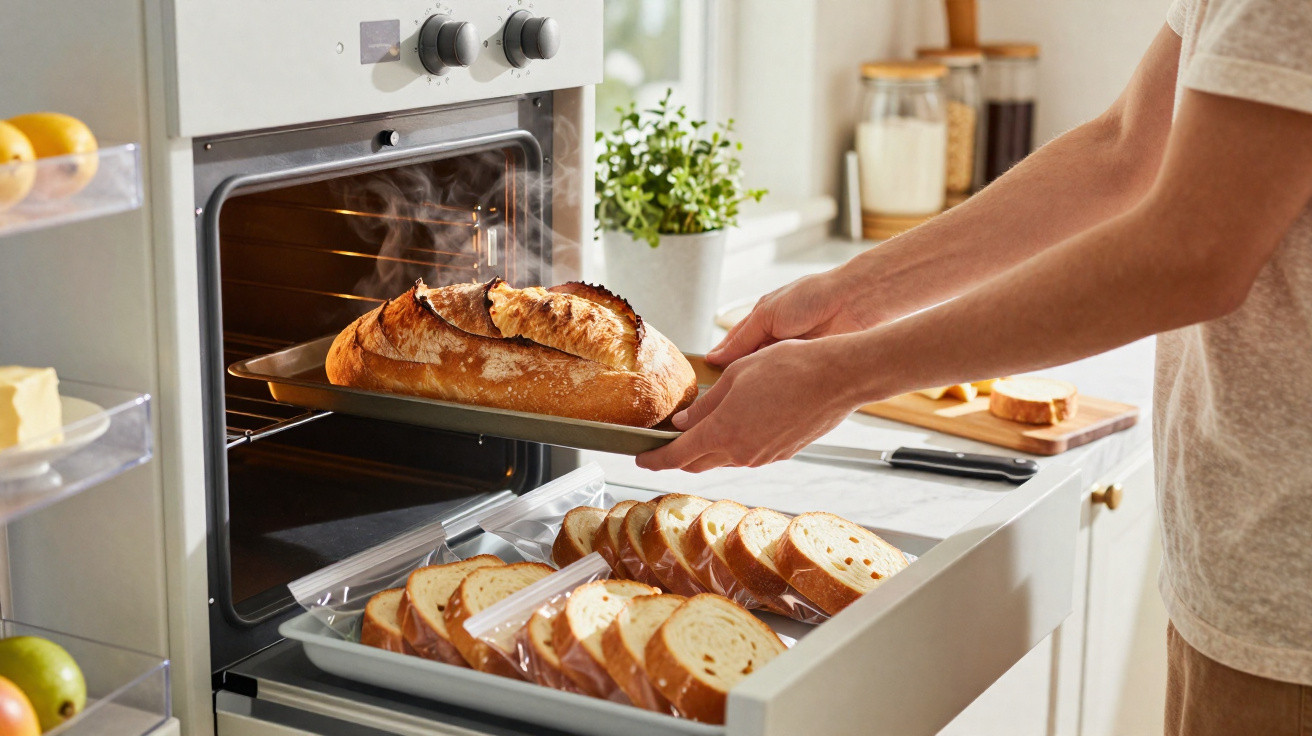
If you only thaw bread at room temperature, the result is rarely great. The make-or-break step comes afterwards in the oven or toaster.
Whole loaves and larger pieces
This approach works well for bigger pieces:
- Thaw overnight at room temperature, ideally on a wire rack.
- Preheat the oven to 150–180 °C (conventional heat: top and bottom).
- Lightly mist the crust with water or rub it with a wet hand.
- Bake on the rack for 5–8 minutes until the crust feels crisp again.
That brief blast of heat helps the starch partially rearrange again and makes the surface noticeably crisper. It won’t turn it back into a just-baked loaf, but it’s a clear improvement over bread that’s merely thawed.
Slices straight from the freezer
Pre-sliced bread has a practical advantage: it can go from frozen to hot immediately.
- Put frozen slices straight into the toaster.
- Set the toaster slightly higher than you would for fresh bread.
- Or quickly toast the slices in a dry frying pan on both sides.
In a few minutes you get bread that’s genuinely enjoyable for breakfast or supper, and it tastes far better than slices that were left to thaw slowly and then served cold.
White patches on frozen bread: mould or just freezer burn?
People often panic when they spot pale marks on bread that’s been frozen for a few weeks. In most cases it isn’t mould, but cold damage - often called freezer burn.
These dry, light areas form when moisture evaporates from the surface and turns into ice crystals inside the bag. Common causes include:
- packaging that leaks or isn’t sealed properly,
- too much air left in the bag,
- large temperature swings in the freezer.
“Freezer burn looks paler and drier, smells neutral, and doesn’t show the greenish or furry growth typical of mould.”
Those patches may taste a bit bland or dry, but they are generally not a health concern. You can cut them off, or if the affected area is small, bake the bread and eat the rest. True mould is different: it often appears as furry grey, green, or black spots and is frequently accompanied by a musty smell. In that case, the whole loaf should be thrown away.
How long bread should stay in the freezer
Bread lasts far longer in the freezer than in a bread bin, but its flavour fades over time. As a rough guide:
- White bread and rolls: best within 1–2 months
- Mixed flour loaves: around 2–3 months
- Dark wholemeal loaves: up to 3 months, sometimes a little longer
Bread that’s been frozen longer isn’t automatically unsafe, but the aroma and texture can deteriorate noticeably. Labelling bags and using the oldest ones first helps avoid disappointment.
Practical tips to cut bread waste
A few simple routines can stop bread going off or drying out before it ever reaches the freezer.
- Buy or bake only the amount you realistically expect to eat within two days.
- Decide straight after shopping which part should go into the freezer.
- Turn leftovers that are already a bit dry into breadcrumbs, croutons, or a bread bake.
That way far less ends up in the bin, and the freezer stash stays manageable. Once you get used to putting bread “on pause” soon after it has cooled, you save money, time, and frustration - and you’ll get much better slices out of the freezer.




Comments
No comments yet. Be the first to comment!
Leave a Comment