
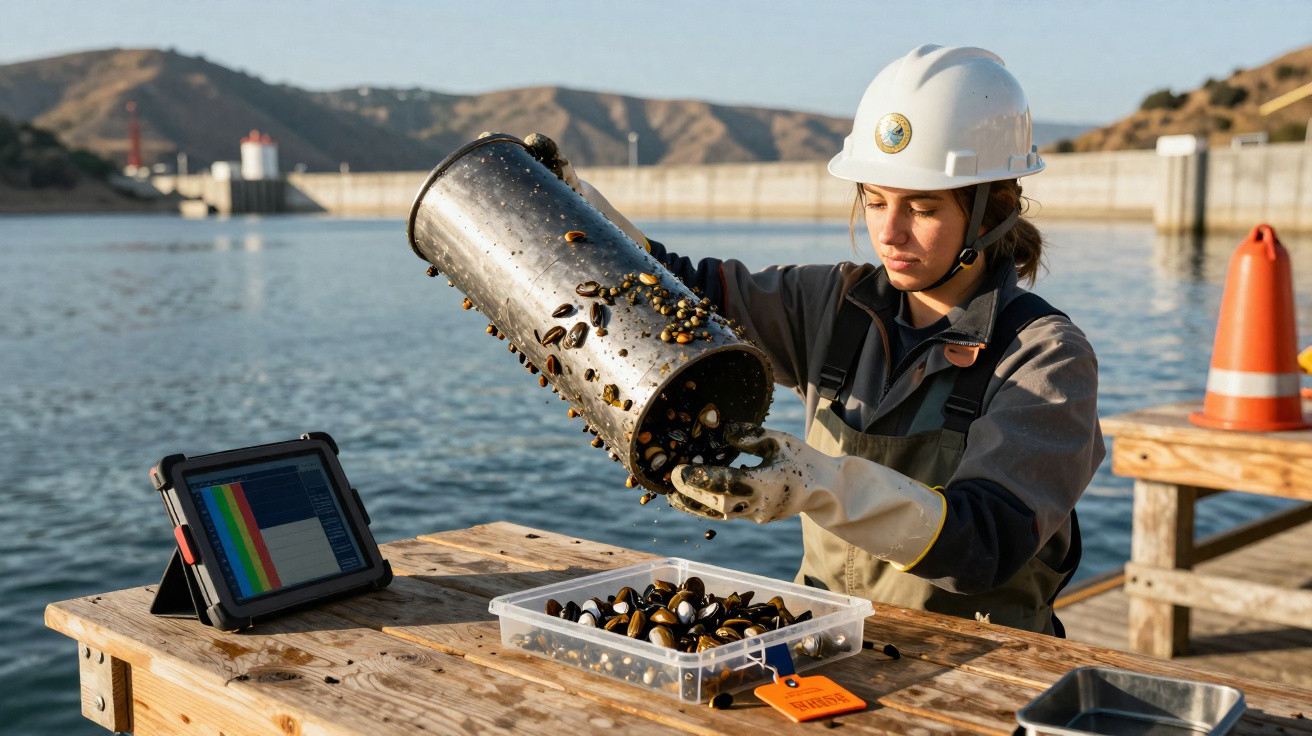
California is now dealing with the arrival of invasive mussel species, and the U.S. Bureau of Reclamation has responded by launching a competition designed to slow their spread. These molluscs foul water infrastructure and rack up staggering costs for the United States year after year.
Calling the bill “astronomical” is no overstatement: the damage caused by these invasive mussels is estimated at 1 billion dollars per year nationwide, a figure on a par with the budgets allocated to some medical programmes. Three species are in question: zebra mussels (Dreissena polymorpha) and quagga mussels (Dreissena rostriformis bugensis, or Dreissena bugensis), which have been present in US inland waters for decades, and golden mussels (Limnoperna fortunei), detected in California for the first time in October 2024.
On top of being largely inedible (they concentrate various heavy metals and pathogens), they attach in colonies to any hard surface-pipes and hydraulic pumps, power-sector equipment-and multiply to the point where these systems become difficult to operate.
To tackle the outbreak, the U.S. Bureau of Reclamation has launched a three-phase challenge called “Halt the Hitchhiker”. The aim is to identify a way to neutralise them inside boats’ ballast tanks, their main route of spread. To attract members of the public, university teams, start-ups and independent US researchers, the federal agency is putting serious money on the table: the minimum prize is 20,000 dollars, but it can rise to a maximum of 200,000 dollars.
Small mussels, enormous damage
As outlined above, these mussels travel via the ballast compartments of leisure craft. These are tanks built into boats that owners fill and empty to adjust the boat’s trim while underway.
Even once drained, the tanks still hold a small amount of water, which can contain the mussels at the larval stage. They are microscopic, so it is impossible to spot them with the naked eye. All it takes is for a boater to empty a ballast tank into a lake, tow the boat home, then relaunch it the following weekend in a different body of water-and the colonisation of a new ecosystem can begin.
After they reach a new lake or reservoir, they latch on to any available surface and build extremely dense colonies that can disrupt the proper operation of hydraulic installations. The impact can be severe enough to reduce flow rates in pipes supplying freshwater to cities and to vast irrigation networks, leaving farmers without the water required for their crops. Industrial facilities and hydroelectric dams are also affected, because once established, colonies can clog systems that are essential to keeping those sites running.
Hunting down the mussels!
For the U.S. Bureau of Reclamation, this has been a priority for just under 20 years. Yet despite millions of dollars spent and the rollout of strict boat-cleaning protocols, no miracle solution has been found so far.
The agency has therefore opted for a different approach with the “Halt the Hitchhiker” competition, hoping to break the relentless cycle of lake-to-lake contamination and automate ballast decontamination without any human intervention.
It has appointed the company yet2 to run the programme-an international open-innovation consultancy-which will deliver it in three stages. First, participants must submit written notes explaining how they would neutralise mussel larvae; six teams will be selected at this point, and each will take home up to 25,000 dollars.
The top three will then move on to an oral presentation to a jury to defend their method, with 50,000 dollars available for each chosen team. The final stage is the toughest: the remaining teams must build a prototype and test it in a laboratory to demonstrate it works. First place will receive 125,000 dollars, second 75,000 and third 50,000. Only the team that finishes first in this final phase, having also won the two earlier rounds, will lay hands on the jackpot: 200,000 dollars in total.
Presse-citron’s analysis
While it used to be relatively unusual for a US government agency to rely on competitions, this has become an increasingly popular public-policy tool known as a “Prize Challenge”. Traditionally, government favours tenders: it contracts suppliers to deliver specific outputs, with funding tied to carrying out the work rather than to achieving a guaranteed end result. In a competition format, the agency flips that logic: it rewards the winner only if they can provide a proof of concept that genuinely works. Two complementary approaches.
It is also a way of admitting that in-house expertise benefits from being challenged by fresh perspectives. In other words, they are betting that an outsider will spot an idea their own staff-heads down on the same problem for nearly 20 years, and therefore too close to it-have missed.





Comments
No comments yet. Be the first to comment!
Leave a Comment