
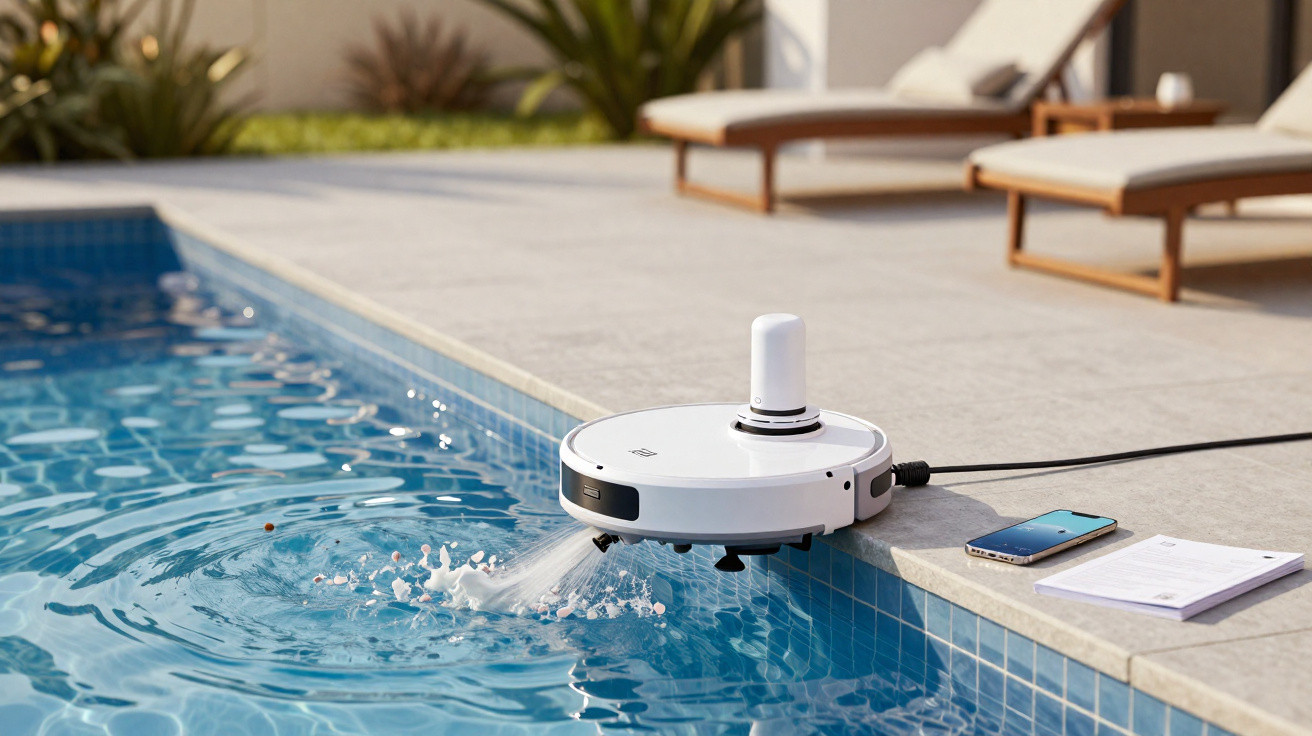
With the Rover X10, Mova has launched one of the few pool robots priced above €2,000. Its four thrusters, underwater LiDAR, 38 m³/h suction rate and promised coverage of seven cleaning zones certainly make a strong case. We tested it for a month to find out whether such a hefty outlay can be justified.
At this rate, Mova will soon be running out of household surfaces to clean. Having already tackled our floors, lawns and even windows in our recent review of the N1 window-cleaning robot, the Chinese brand is now diving into swimming pools. This expansion is being pursued at pace, following the same formula: rapidly covering every new category with several products.
Pools are no exception. Last March, Mova introduced its first pool robot range, comprising the Diver R10 (€199), Diver A10 (€699) and the striking Rover X10, priced at €2,499.
At that price, the Rover X10 occupies a very exclusive market. There are few options once prices exceed €2,000. What is more, this premium segment is currently dominated by Chinese manufacturers, including Beatbot with its €3,850 AquaSense 2 Ultra and Aiper with the €2,499 Scuba X1 Pro Max.
To earn its place, the Rover X10 needs an imposing specification. It features four vertical thrusters, laser mapping beneath the water, 38 m³/h suction, inductive charging and a pledge to clean seven areas, including steps and corners. Our 40 m² pool acted as the final test of this extravagant package for one month.
A sea monster with its own little buoy
Even before it enters the water, the Mova Rover X10 pool robot makes an impression. Next to it, the Beatbot Sora 70 and Aiper Scuba V3 - the two other robots tested in our pool this summer - almost look like toys. Mova's model measures 54 cm long, 46 cm wide and weighs a substantial 15.8 kg. That is nearly twice the weight of the Scuba V3.
Its build quality matches its considerable dimensions. A broad-shouldered anthracite shell surrounds a glossy black central panel, while the blue brushes provide the only splash of colour. On top, four vertical thrusters sit close to the robot's four corners around a mapping turret.
Two thick tracks run down its sides, while small side brushes project at the front to gather dirt from around the pool's edges. The contents of the box are equally substantial. Mova includes a sizeable wireless charging station, its power supply, a retrieval hook, an ultra-fine 3-micron filter and, above all, an unusual accessory called AquaSonar.
This is a small round float, though its purpose is far from trivial. Kept on the surface, it remains connected to Wi-Fi and communicates with the submerged robot using ultrasound. The app can therefore continue monitoring its work, showing the battery level and even the water temperature.
The AquaSonar also lets you retain control of the Mova Rover X10 and steer it remotely, particularly to bring it back to the pool edge while it is operating underwater. This is a major advantage, as most pool robots become unresponsive once submerged.
Despite all this equipment, setup is reasonably straightforward. The MOVAhome app quickly detects the Rover X10 over Bluetooth before connecting it to the home's Wi-Fi network. The AquaSonar float then needs to be paired separately.
Underwater LiDAR, but unreliable mapping
When placed on the water, the Rover X10 does not sink immediately. In fact, it takes its time. During our tests, it regularly needed close to ten minutes to take on enough water and reach the bottom, whereas the app estimates this process at three minutes.
Its full array of technology only comes into play once it is submerged. The AquaScan turret on top incorporates an underwater LDS designed to measure the pool's contours, supported by 29 sensors distributed around the machine. Mova promises 3D mapping and routes adapted to the pool's geometry.
Our experience on this front was mixed. As Wi-Fi coverage was fairly poor by our pool, even the AquaSonar struggled to relay information. We therefore removed the robot after its first descent and moved it closer to the house. Yet, despite three further attempts, we could not obtain the map displayed in the app.
The Rover X10 pool robot nevertheless appeared to understand our pool's dimensions perfectly well. Its movements were steady, with no hesitation or unnecessary U-turns, and it correctly identified both our corner staircase and the return jets positioned on the walls.
Otherwise, the app is particularly comprehensive. It can target the floor, walls and waterline, the surface, floor edges and shallow areas such as a submerged beach. Mova describes this as 7-in-1 cleaning by counting corners and steps separately, although neither has a dedicated programme.
There are three suction settings, along with the option of selecting one or several passes depending on the chosen mode. Weekly scheduling and a function to call the robot back to the pool edge are also available.
Powerful performance across almost the entire pool
With 38 m³/h of suction, the Rover X10 has no shortage of power. This is simply the highest flow rate we have tested so far on a pool robot. Its 5-litre basket is also generously sized, although its overall bulk suggested there might be room for more. The significantly more compact Beatbot Sora 70, for instance, has a 6-litre capacity. Mova compensates with dual filtration rated at 180 and 3 microns.
On the pool floor, the Mova performs extremely well in any case. It progresses methodically, collecting leaves, sand and small gravel without difficulty. The small side brushes also contribute by pushing debris along the edges towards the suction inlet.
Its four vertical thrusters come into their own when the job becomes more demanding. They allow the Mova Rover X10 to manage its thrust and remain firmly against the lining as it leaves the floor to tackle a wall. This rather spectacular design delivers results all the way to the waterline. The robot climbs confidently and spends enough time there to leave it clean after passing.
Our corner steps proved more challenging. The Rover X10 detects them properly, but its size becomes a disadvantage here. It is not particularly slim, leaving it little room to sit neatly on each step.
The result will naturally depend heavily on the design of your staircase. The wider and deeper the steps, the more room the X10 has to manoeuvre. In a tight corner such as ours, its sizeable frame ultimately works against it.
Nuclear-submarine stamina
With its 15,000 mAh battery, the Mova Rover X10 delivers endurance to match its weight. The brand claims up to six hours of floor cleaning and as much as twelve hours on the surface. In our 40 m² pool, our various measurements showed that a complete cycle used around one quarter of the battery.
In other words, the X10 could manage roughly four major cleaning sessions before requiring a recharge. During the peak season, when a pool is used frequently, two to three runs per week are generally recommended. At that pace, our Rover could remain away from its station for more than a week.
A full recharge still takes 6 h 30. Fortunately, Mova has made the process more refined with an elegant wireless dock. Simply placing the Rover X10 on it begins inductive charging. It is welcome convenience, even if you first need to carry nearly 16 kg to the base.
The AquaSonar has its own battery as well and must be charged separately using the supplied adaptor. Used only occasionally to relay a few commands during cleaning, particularly because our connection was poor, it lasted an entire month without needing to be plugged in.
A nearly theoretical price for the Mova Rover X10 pool robot
At Presse-Citron, we always state a product's launch price, as pricing can change quickly after release. In this case, however, a brief digression is useful. Much like Xiaomi in the smartphone market, Mova is never hesitant about offering steep discounts, sometimes very soon after its products launch.
The Rover X10 is an excellent example. Released at €2,499 last spring, it was listed at €1,299 on the manufacturer's website when these lines were written. That is almost half the price.
At this level, the technology-to-price equation changes completely. It is no longer only competing with the limited number of pool robots priced above €2,000, but also with models such as the Aiper Scuba V3 and Beatbot Sora 70.
Our verdict on the Mova Rover X10 pool robot
Sometimes, excess can be a good thing. With the Rover X10, Mova has piled on motors, sensors and features in a way few manufacturers have attempted before. After a month in our pool, it is clear that this technological abundance provides genuine benefits underwater.
Its 38 m³/h suction cleans the floor effortlessly, it climbs walls decisively and it handles the waterline particularly well. Surface cleaning was also convincing. Above all, its battery life is the best we have recorded so far from a pool robot. Add filtration down to 3 microns, weekly scheduling and an inductive charging station, and the Rover X10 makes complete sense for a large pool that is used regularly.
However, this extensive equipment does not succeed in every area. We were never able to obtain the promised 3D mapping, the AquaSonar depends heavily on Wi-Fi range, and the robot's 15.8 kg weight soon becomes tiresome to handle. Its huge footprint is also poorly suited to narrow staircases.
Ultimately, the Rover X10 is best suited to large, simply shaped pools, where its suction power, endurance and automation can be used to their full potential. In a smaller pool or one with a narrow staircase, its excess becomes much harder to justify. Its original €2,499 price is therefore likely to give buyers pause. As Mova is known for substantial promotions, a little patience may be enough to settle the matter.
Mova Rover X10
€1499
9.1
Installation and build quality
9.5/10
Navigation and obstacles
9.0/10
App and features
8.5/10
Cleaning performance
9.0/10
Battery life and charging
9.5/10
What we like
- Powerful 38 m³/h suction
- Excellent results on the floor, walls and waterline
- Outstanding battery life
- 3-micron filtration included
- Comprehensive app and inductive charging base
What we like less
- Unable to obtain 3D mapping during our test
- AquaSonar reliant on Wi-Fi range
- Imposing size and weight
- Not especially effective on narrow staircases
- High launch price



Comments
No comments yet. Be the first to comment!
Leave a Comment